A tie nut that will not turn is usually reported as an overtorqued rod. It rarely is. Galling seizes a thread at a fraction of the rod's rated load, with no visible warning and no deformation to show for it, and the operator often reports that it locked up with almost no effort. Understanding the mechanism is what makes it preventable, because every effective countermeasure works on one of three things: the surface, the pressure, or the speed.
What galling actually is
Galling is cold welding between two metal surfaces under pressure. When contact pressure between thread flanks rises, the protective oxide film on both surfaces ruptures, and the exposed metal underneath bonds. The bond is stronger than either parent material, so as the nut continues to turn it tears metal from one flank and smears it onto the other. The thread profile is destroyed as it turns, which is why the damage is progressive and why the nut gets harder to move the further it goes.
Why it happens on formwork
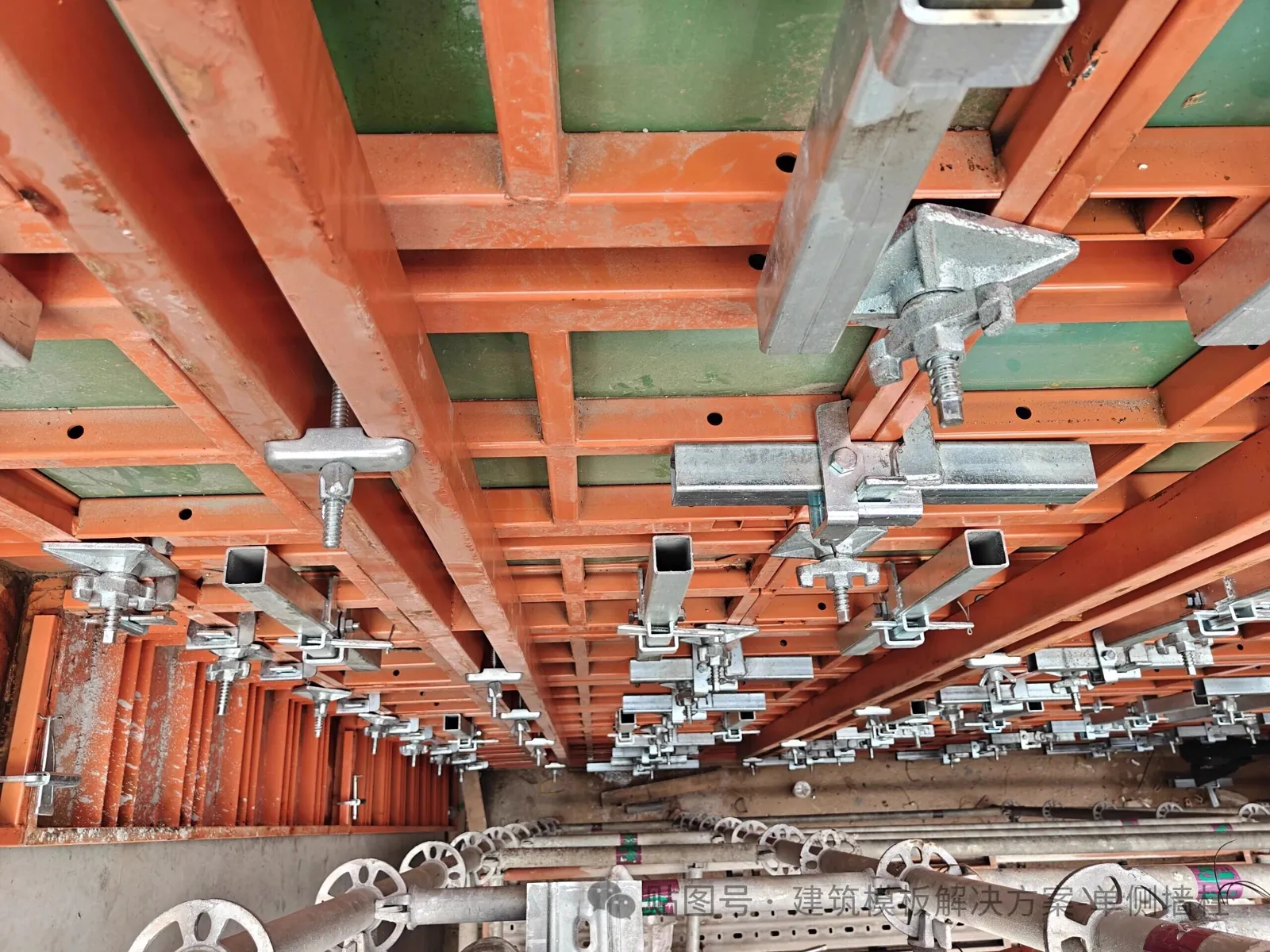
Formwork tie assemblies are close to a worst case for this failure. The conditions that promote galling are all present at once:
- Two similar metals in direct sliding contact, most often a galvanized rod running into a galvanized nut.
- High thread-flank pressure, because the nut is doing real work rather than merely clamping.
- Long engagement, so a single tie presents many thread pairs that can each start a weld.
- Site conditions, with grit and dried concrete dust embedded in the threads.
- Fastening with a powered wrench, which raises contact temperature and sliding speed at the same time.
Which combinations gall most
The risk depends on the pairing of materials, not on the strength of either part. Higher grades resist tensile load better but are not more resistant to galling.
| Rod | Nut | Galling risk | Note |
|---|---|---|---|
| Galvanized carbon steel | Galvanized carbon steel | Moderate | Coating acts as a separator until it wears through |
| Bare carbon steel | Bare carbon steel | Moderate | Common on painted or oiled stock, with same-metal contact |
| Stainless austenitic | Stainless austenitic | High | The classic galling pair, and the reason stainless tie systems need a lubricant |
| Stainless austenitic | Galvanized carbon steel | Moderate | Dissimilar pairing is more forgiving, but introduces corrosion risk |
| Any grade with dry film lubricant | Same grade | Low | The lubricant is doing the work, not the material |
Prevention at the specification stage
Decisions taken at the quotation stage are the cheapest ones, because they cost nothing to implement on site.
- Specify a coating on at least one of the two parts, so the contacting surfaces are dissimilar.
- Specify dry-film lubricant or a molybdenum-based anti-seize on stainless assemblies as a condition of supply, not as a site option.
- Keep the thread finish consistent between rod and nut; a rolled thread running against a cut thread behaves differently from a matched pair.
- Ask for the nut to be supplied matched to the rod, so engagement length and pitch are known rather than assumed.
- Include a torque range in the requisition instead of a single target figure, so the site has a lower bound as well as an upper one.
Prevention on site
- Keep threads clean. Grit embedded in a nut is an abrasive as well as a point of high local pressure, and one contaminated thread pair can seize an entire tie.
- Use a slow, steady wrench speed rather than full trigger. Speed and contact pressure are the two variables an operator actually controls.
- Stop turning the moment resistance rises unexpectedly. Galling is progressive, and the first stiff half-turn is the cheapest point to stop.
- Do not reuse a nut whose plating has been worn down to bare metal on the flanks.
- Never chase a tight nut with more torque. Torque above the specified range does not seat the formwork any better, and it is the most common way a recoverable joint becomes an unrecoverable one.
When a tie has already seized
The first attempt should be chemical and gentle: penetrating oil, a short wait, and working the nut back and forth through a fraction of a turn rather than in one direction. The second is a controlled application of heat to the nut only, which expands it away from the rod; heating the rod instead makes the problem worse. If the flanks have cold-welded over a full turn, the tie is a lost item and the correct move is to cut it out. Continuing to force it risks shearing the rod inside the formwork, which turns a fifteen-minute fix into a panel-stripping job.
What to specify next time
Two lines in a purchase requisition prevent most of it: the coating or lubricant state of both mating parts, and a torque range rather than a single value. A supplier who is told that the rods will be tensioned with powered wrenches and reused across several pour cycles can propose a pairing and a lubricant that survive that duty. A supplier who is given only a diameter, a grade and a price target will supply a dimensionally correct tie that seizes on the first busy day.