
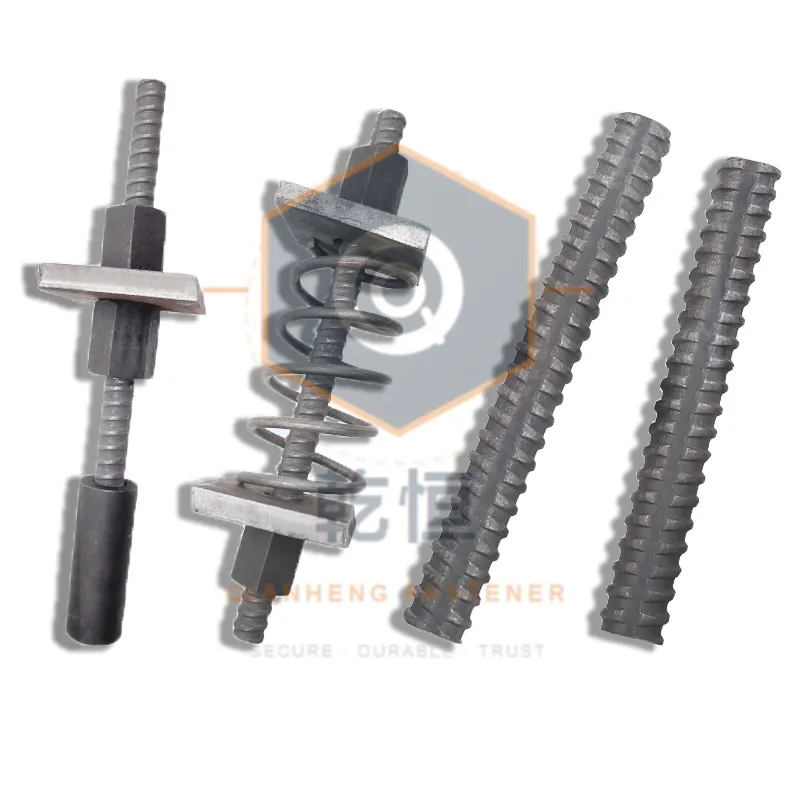
Prestressed threaded bars look similar to heavy tie rods but are specified differently, because they carry permanent load in the finished structure rather than temporary load during construction.
Where they are used
Post-tensioning anchorage zones, ground anchors and soil nails, tie-downs for wind uplift, column-to-base connections, precast panel connections, and temporary works where very high tension is required in a compact section.
The common thread forms are the hot-rolled coarse types (often written as a nominal diameter with a coarse pitch, e.g. 32 mm or 36 mm class) and metric fine threads on larger diameters. Diameters typically run from 15 mm to 75 mm.
How they differ from formwork tie rods
TEMPORARY vs PERMANENT: tie rods are removed and reused; threaded bars stay in service and are usually protected against corrosion for the design life.
LOAD CONDITION: tie rods see a construction cycle and are derated for reuse. Bars see sustained or cyclic service load and are specified with a proof-load and, in some applications, a fatigue requirement.
COUPLING: bars are frequently joined with couplers that must develop the full bar capacity. Coupler capacity, thread engagement length and the requirement for a proof test belong in the specification.
The four specification items that decide performance
- MATERIAL AND CLASS: typically a quenched and tempered alloy steel with a specified yield and ultimate strength, and a defined minimum elongation. Ask for the chemical composition and the heat treatment record, not just a grade name.
- THREAD AND COUPLER: thread form, class, engagement length and whether couplers are tested to develop full bar capacity. A coupler that strips before the bar yields is a design failure, not a material one.
- CORROSION PROTECTION: for permanent service, the choice is hot-dip galvanizing, epoxy or zinc-rich coating, greased-and-sheathed systems, or stainless for chloride exposure. The protection must survive handling, installation and stressing, and it must be repairable at damaged points.
- STRESSING AND PROOF LOAD: the specified proof load, the extension tolerance, and whether a lift-off or load-cell check is required. For ground anchors, the acceptance criteria for creep and load hold are part of the specification.
Handling and installation points that are commonly missed
Do not cut a threaded bar with a disc cutter and then use the cut end for anchorage: the heat-affected zone and the burr damage the thread root. Thread repair after cutting must be done by a controlled method, and the repaired zone should not be the stressed end.
Check thread engagement with the coupler or nut by hand before installation. Bars are stiff, so a cross-thread that starts will not be felt until the wrench is applied, and by then the thread is damaged.
Store bars straight and supported. A bent bar that is straightened has residual stress and a changed fatigue performance, which matters where the load is cyclic.
Documentation
For permanent work, require the mill certificate with heat number traceability, the heat treatment record, the proof-load test report and the coating thickness report. For ground anchors add the installation record and the acceptance test result per anchor.