
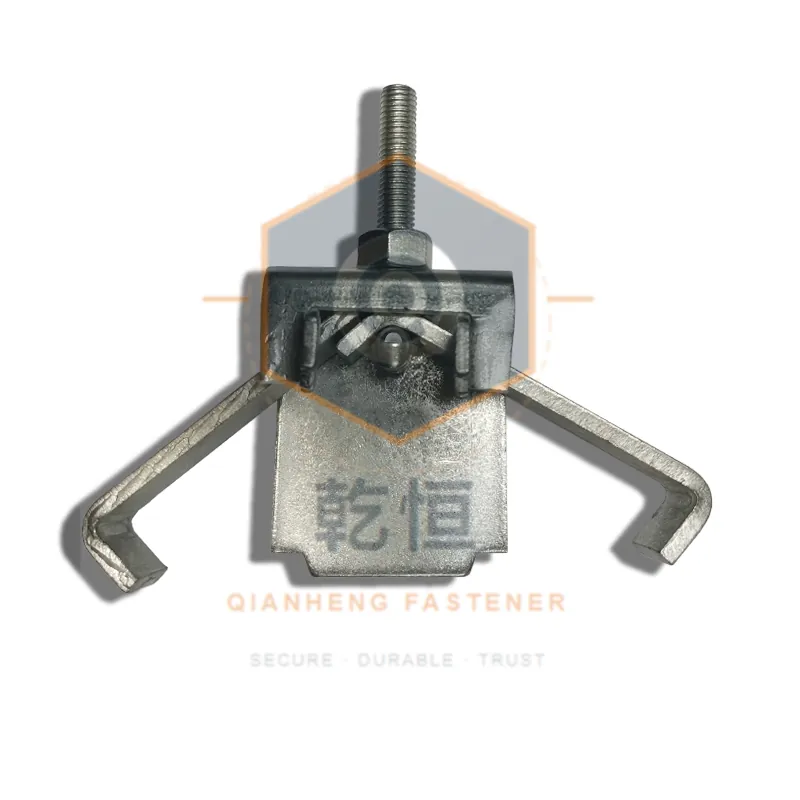
H20 Beam Connector
Joins H20 timber beam ends with clear load transfer and fast installation.
- Fits H20 beam flange (80mm)
- QT450-10 ductile iron hook
- Spring-loaded toothed grip
H20 beam connectors and H20 timber beam clamps for joining and clamping H20 timber beam formwork systems.
H20 timber beams carry the panel load back to the walers, and the joints decide whether the system stays stiff. This series covers the H20 beam connector that joins beam ends and the H20 timber beam clamp whose cast-steel claw grips the beam flange.
Joins H20 timber beam ends with clear load transfer and fast installation.

Cast-steel claw grips the H20 beam flange; screw and nut lock it in place.
H20 timber beams carry the panel load back to the walers, and the beam joints are where a slab form loses its line. The H20 beam connector joins two beam ends so the splice carries moment rather than acting as a hinge; the H20 timber beam clamp grips the beam flange to fix a waler, a prop head or a bracing point without drilling the beam. Both parts are reused across many cycles, so the grip and the casting quality matter more than the unit price.
The clamp fits the standard 80 mm H20 beam flange. The hook is QT450-10 ductile iron with a spring-loaded toothed grip that bites the flange instead of relying on friction, and the wedge lock needs no tools, so it goes on and off in seconds with gloves on. Check the flange width on your beam supply before ordering — non-standard timber beams are the usual cause of a clamp that will not seat. Connectors are matched to the beam depth so the splice sits flush with the beam face.
These are long-life parts, so the order quantity follows the number of beams in the system plus spares — a clamp lost on site stops a beam from being fixed. Standard clamps and connectors ship from stock in about three days, special castings in 7–15 days. Ductile iron with black or galvanized finish; galvanized is worth specifying where beams are stored outdoors between cycles.
A formwork tie rod is a high-strength threaded bar that, together with nuts, anchor plates and walers, holds formwork panels against the lateral pressure of fresh concrete. It passes through the wall section and is either fully recovered after stripping (through-tie used with a sleeve) or permanently embedded (lost-end / water-stop type).