
Seven Nuts on One D15 Rod: Why \"Nut M16\" Is the Most Expensive Three Words in a Tie Assembly
> In brief > - Specify the nut's function and load path, not just the thread, to ensure correct procurement. > - Always order nuts and their matching plates in the correct quantities to avoid installation failures. > - Use the bearing face geometry, not markings, to reliably identify and specify the correct nut. > - Ensure the nut is specified by function and rating, not by property class, to prevent incorrect catalog selection.
A tie rod order is usually written by somebody who is thinking about one hole. The line says "tie rod D15, 1.2 m, with nut and washer", the supplier reads it as a standard assembly, and the goods arrive. On the day, the crew opens the bag and finds that the nut has no plate behind it, that the plate has no nut to hold it, or that the nut is a coupling nut that has no business being at the end of a rod at all. The rod is correct. The wall is not ready. The formwork is closed in four hours and the nut that came with the rod does not go on it.
None of this is a supplier failure in the ordinary sense. Every part delivered is a real part, of a real grade, at a real price, and in most cases exactly the part the supplier believes was ordered. The failure happened earlier, in the sentence. "Nut M16" is not an incomplete specification that a good supplier completes from experience. It is a specification with several mutually exclusive readings, and the one that gets chosen is decided by which nut happens to be in the warehouse on the day the order is picked.
The reason the ambiguity exists at all is that the tie rod nut family genuinely shares one thing. Every nut on a D15 rod takes the same M15 thread, in the same pitch, to the same tolerance class. That shared thread is what makes them look interchangeable on paper. It is also the single most misleading fact about them, because thread compatibility is necessary for a nut to fit and tells you nothing about whether it will work. What separates the family is the bearing face, and the bearing face is what the purchase order has to describe.
This is not a peculiarity of this product family. It is the general condition of any fastening in which several parts share an interface, and structural bolting has had to solve it formally. Guidance on high-strength structural bolting for preloading, for example the RSCJ guidance published through the Steel Construction Institute, is explicit that a bolt is only one component of an assembly and that the assembly capacity is set by its weakest member, which is why manufacturers publish assembly data rather than component data (RSCJ High-Strength Structural Bolting). The tie rod nut has exactly the same property and exactly the same consequence: naming the thread names the interface, and the interface is the one thing the whole family shares.
The family divides cleanly into four functional groups, and a buyer who can name the group is already most of the way to a correct order:
| Group | Parts | What it does | What it needs to work | Load approach |
|---|---|---|---|---|
| Self-bearing | Cast iron disc nut, double-lug disc nut | Carries the tie load through its own face | A washer, so it does not turn into the panel | Rigid, high, up to about 180 kN |
| Plate-dependent | Mountain nut and mountain disc, plum washer | Carries load through a separate plate that spreads it | Its matched partner, always | Rigid, moderate, spread wide |
| One-piece | Combination nut, cast iron water stop nut | Nut and disc are one casting or pressing | Nothing, but it cannot be reconfigured | Rigid, with a water stop option |
| In-line | Connecting nut, coupling sleeve | Joins two rod sections, carries no lateral load | Matched rod thread on both sides | Axial only, never bending |
The single most useful sentence a buyer can add to a nut line is about pairing. Wherever a nut and a plate are two parts, the quantity of one is not the quantity of the other, and the order has to say which way the count runs. A mountain nut without a mountain disc does not become a weaker version of the same joint; it becomes a wing nut rotating on a flat plate, which is the failure mode the plate was designed to prevent.
Nut M16 is a specification with several mutually exclusive readings, leading to potential procurement errors. Bearing face refers to the geometric feature of a nut that determines its function and load-carrying capacity. Self-bearing nut means a nut designed to carry the tie load through its own face, typically with a flat machined surface. Plate-dependent nut refers to a nut that carries the load through a separate plate, requiring a matched partner. One-piece nut means a nut and disc combined into a single casting or pressing, suitable for rigid joints.
1. Why one rod accepts seven different nuts.
The tie rod is the only structural fastener in the formwork assembly that is deliberately not unique. It is a plain threaded bar, and it has to be, because it passes through a hole, a sleeve, a waler and a panel, and every one of those parts has to be threaded to the same standard or the assembly cannot be built at all. The rod is the constant. Everything bolted to its ends is designed around it, which is an unusually clean engineering arrangement and one whose consequences for procurement are almost entirely unrecognised: when the central component of an assembly is deliberately standardised to the point where it cannot distinguish any of its own satellite components, the specification burden shifts entirely onto the satellites, and a specification system that has evolved around the idea that a part number identifies a part stops working at exactly the point where it is needed most.
That single decision is what produces the nut family. Once the rod thread is fixed, any nut that engages it can be fitted, and the design question becomes which nut suits which joint. A wall formwork tie ending on a timber waler wants a wide bearing face so the nut does not embed into the timber. A tie ending on a steel waling wants a plate because steel will spread the load itself and the plate stops the nut marking the section. A rod that needs extending in the middle of its length wants a coupling nut, which is a completely different component that happens to share the thread. A tie that ends in a water-retaining wall wants a nut with a water stop in it. Each of these is a different nut, and all of them take the same thread.
The fastener property that governs this decision is documented in the standard for the bolts themselves. ISO 898-1 sets out the mechanical properties of steel bolts, screws and studs by property class, and ISO 4032 covers hexagon nuts, but the formwork nut family sits mostly outside both, because formwork nuts are predominantly hand-tightened castings and pressings rather than property-classed fasteners (ISO 898-1). That is worth stating in a specification as well: the nut is specified by function and rating, not by property class, so a supplier filling the order from a standard fastener catalogue is filling it from the wrong catalogue.
The consequence for a buyer is that the thread is the one parameter that never distinguishes anything. A specification that carries only the thread is specificationally empty in the dimension that matters. This is not a peculiarity of this product family. It is the general condition of any fastening where several parts share an interface, and the professional response is always the same: describe the function and the load path, not the interface everyone already knows.
The second consequence is about returns. Because the parts fit each other mechanically, a wrong nut cannot be detected by the supplier, cannot be detected by the freight forwarder, and will not be detected by the crew until the rod is already in the wall. It will be detected at the moment of installation, which is the most expensive possible moment, because by then the formwork is assembled and the alternative is to strip it back.
2. The bearing face is the part number.
If a buyer learns one thing about this family, it should be that the geometry of the bearing face identifies the nut more reliably than any marking on it. Markings are lost in galvanising, in handling and in translation. Bearing geometry survives all three, because a machined circular face, a wedge profile and an integral flange remain recognisable after any coating process, any amount of site handling and any number of documentation translations, whereas a stamped size designation on the shoulder of a casting becomes unreadable the moment the part is galvanised and becomes a liability the moment it is transcribed by somebody who reads it differently.
There is a dimensional reason for this as well as a documentary one. The bearing face is a geometrically defined feature whose diameter and flatness are established by machining, and machining tolerances on a large cast iron face are held to a fraction of a millimetre across a D90 to D120 circle, which means the face is repeatable between production runs in a way that a stamped marking never is. Repeatable geometry is what makes a component identifiable on arrival; a marking is only ever a claim about geometry, and a claim can be wrong.
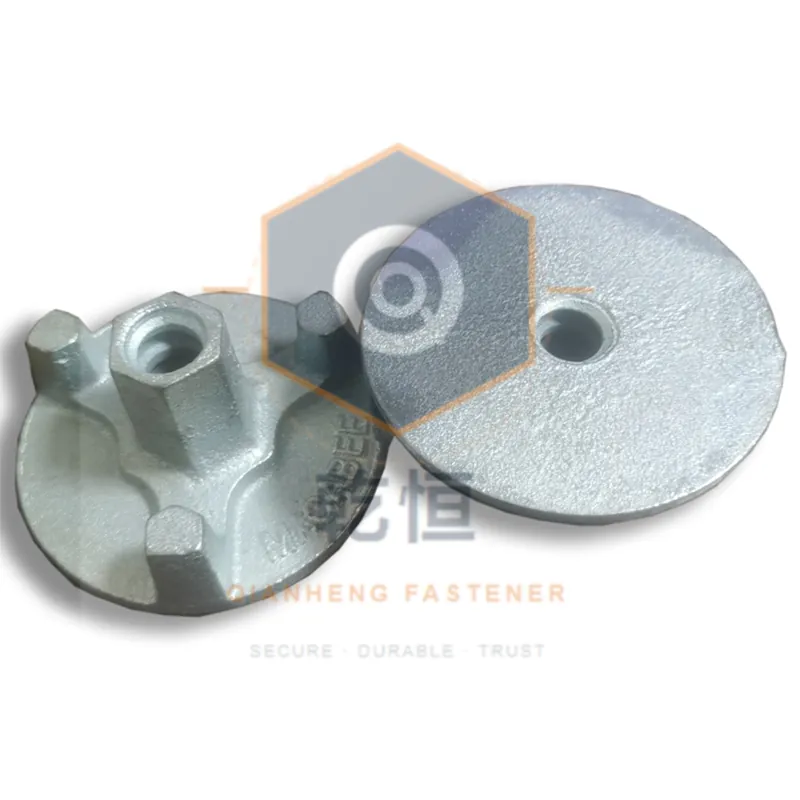
A flat machined face means the nut is self-bearing. It is designed to carry the whole tie load through its own circular face into the material behind it. This is the property that allows a cast iron disc nut to be fitted to a rod with nothing else behind it, and it is why those nuts are cast or forged heavy rather than stamped thin. The flat face has a diameter worth stating in the order, because that diameter is the number that determines whether the panel behind it gets marked or crushed.
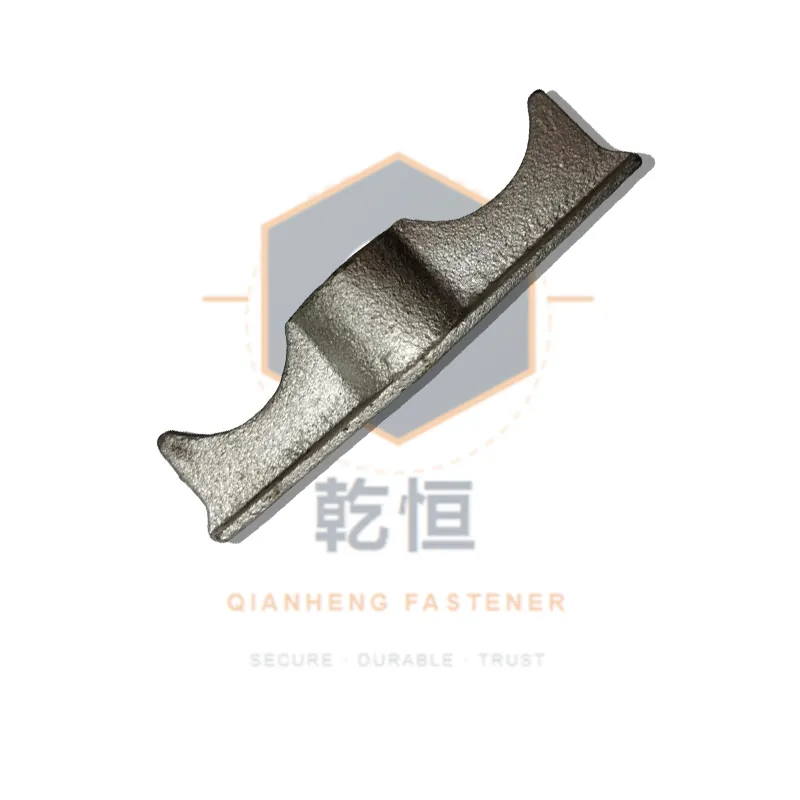
A lobed or wedge profile means the nut is plate-dependent. A mountain nut is essentially a wing nut with a shaped underside, and the shape only develops load when it is clamped against a matching mountain disc with a raised profile. Loose in the bag it is a hand-tight nut; on the rod against bare timber it is a hand-tight nut that will turn under the first significant lateral load the concrete applies. The plate is not an accessory here, it is half the joint, and this is the single most important observation in the whole family because it is the one that turns an apparently complete delivery into an incomplete assembly: a bag containing a hundred mountain nuts and a hundred flat washers is not a kit of a hundred mountain joints, it is a hundred wing nuts rotating against a hundred washers, with the spreading function that the design depended upon entirely absent.
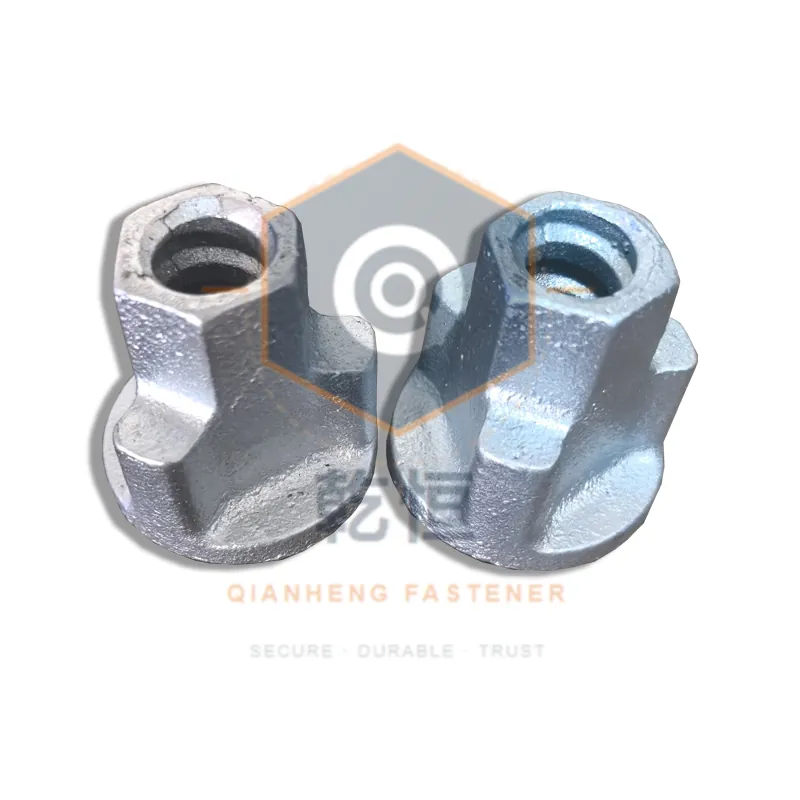
A dished or flanged body means the nut is one-piece. A combination nut carries its disc integrated into the same body, either as a single pressing or as a nut welded into a plate. This is a genuine engineering choice with a genuine trade-off: it halves the parts count and removes the possibility of pairing the wrong plate with the wrong nut, and in exchange it removes any ability to change the bearing diameter without changing the nut. It also tends to be the heaviest option per hole, because the plate cannot be optimised independently.
A long slender body with no wings and no disc means the nut is in-line. A connecting nut is a sleeve threaded internally at both ends whose job is to extend a rod or to join an embedded bolt to an outer tie rod in single-sided formwork. It is the one member of the family that is not a termination at all. It sits in the middle of the assembly, carries axial load only, and must never be asked to resist bending, because its body wall is thin and it has no bearing face to react against anything.
The three bench observations that follow from this are the practical version of the whole method. Look at the face, look at the body surface, look at what the part does. That is enough to place any loose nut into one of the seven types within a few seconds, and it is the same three observations a competent inspector will use on a delivery. A buyer who wants a written version of the same routine should keep the four-group table in this article next to the goods catalogue, because the table is not a description of the family but an operating procedure for identifying an unknown part.
3. Material and rating decide what a nut can survive.
The family splits cleanly again on material, and this split is not cosmetic. A nut that carries a structural tie load and a nut that holds a non-structural assembly look similar on a bench and behave completely differently under a working load.
Cast iron and ductile iron nuts are the heavy end of the range. Their body is sand cast, which leaves a visibly rough surface and a parting line, while the thread seat is machined smooth. This combination is the quickest material check available, because a rough body with a machined thread seat is a casting and cannot be anything else. Cast iron nuts in this family are rated at approximately 180 kN of bearing capacity for D12, D15 and D20 rods, with body diameters from D90 to D120 depending on the rod size and the optional welded washer plate. That rating is a bearing rating, not a tensile rating, and the distinction matters when a nut is specified for a heavy tie.
The family reference specification behind the procedure in sections 2 and 3 is worth stating explicitly, because the identification method only works if the four groups are each internally consistent, and the table above is only as useful as the numbers behind it. What that specification also makes visible is how much of the family exists to solve a bearing problem rather than a tightening problem, which is the point that section 4 develops.
Steel nuts in the family are forged or pressed and carry rolled or cut threads. The pressed and forged steel types used for mountain, double-lug and combination nuts in this family are made from 45 steel or Q235, and their capacity is governed by the rod rather than by the nut, because the nut body is not the weakest element. Zinc plating and hot-dip galvanising are both normal finishes, and the choice between them is usually driven by the rod finish rather than by the nut, since a galvanised nut running on a bright rod will gall in service.
The practical rule for a buyer is to state the material and the rating together or not at all. A quotation that says "M16 nut, zinc plated" tells you nothing you can check. A quotation that says "cast iron tie nut, D15, approximately 180 kN bearing, plain finish" tells you the body, the interface, the load the part is rated for and the surface, and you can hold a supplier to all four.
Material choice is also a coating decision, and the two interact badly when they are specified separately. A zinc-plated steel nut running on a hot-dip galvanised rod in a wet wall will gall at the thread, because the two coatings are not a matched pair and the softer zinc coating will smear. The mechanisms and the material pairings that avoid this are covered in detail in thread galling prevention for formwork fasteners and in how coating selection changes the specification, and both of them begin from the same rule: the nut and the rod are specified as one coating system, not as two products.
Standard basis: ISO 898-1
4. What each nut actually does on the formwork.
Knowing the type is not the same as understanding the duty, and the duty is what determines whether the type is right. Each of these parts exists because a particular joint produces a particular problem. The shorter version of this discussion, covering the common hand-tightened options, is in wing nuts, disc nuts and washers; what follows adds the four types that never appear in a general nut catalogue, which are precisely the four a buyer is most likely to order wrongly.
The cast iron disc nut is the termination for a heavy tie landing on timber or on a steel waler without a plate. Its machined flat face spreads the load over a D90 to D120 circle, which is what makes it usable directly against timber. It is the standard answer on a heavy wall or a lift where the tie force is high and the nut will be tightened once and left. The wider question of how that bearing face interacts with the waling behind it, and how much movement the joint tolerates before the nut has to be re-tightened, is a separate calculation from the nut selection itself.
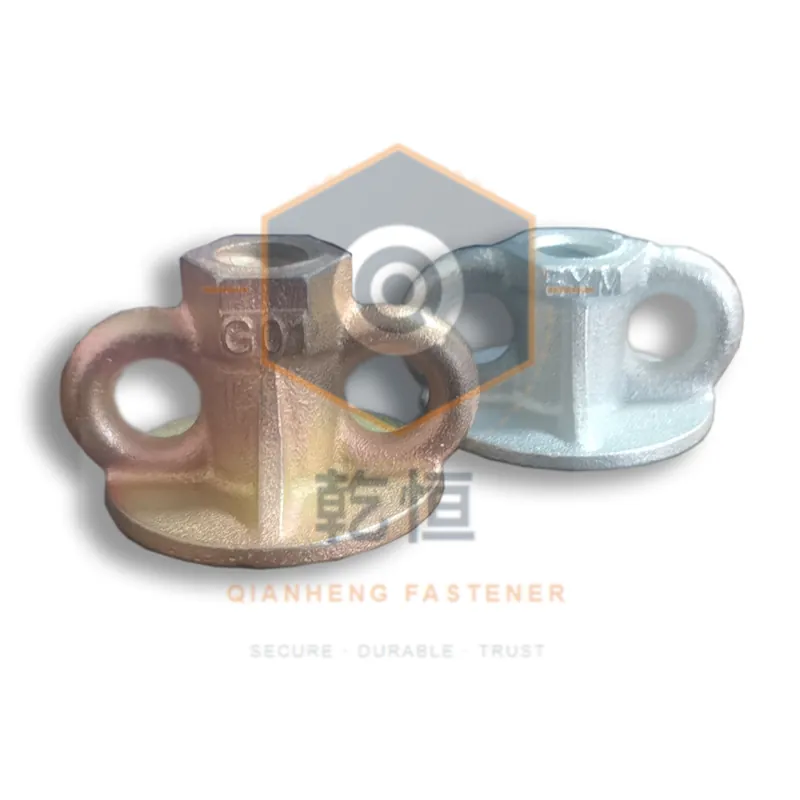
The double-lug disc nut is the same idea in pressed steel with two ears added. The ears exist purely for hand leverage, which speeds assembly when the crew is not using a wrench, and the disc spreads the load the same way. It needs a washer beneath it, because a pressed disc bearing directly on a panel will rotate under a hand-tight nut and slowly mark the face.
The mountain nut and mountain disc are a two-part clamping pair. The disc has a wedge profile that spreads the tie load across a much larger area of waler than any single disc can, and the nut's shaped underside locks into it. This is the preferred arrangement on wide steel waling where the design intent is to keep the waling section unmarked and undistorted. The pair must travel together.
The combination nut is the parts-count answer. One pressing instead of a nut and a plate means one item to count, one item to lose and one item to misorder. It is a sensible choice for a large repetitive wall where the same hole is drilled several hundred times and where the logistics of the site, rather than the structural performance, dominate the decision.
The plum washer is not a nut at all but belongs in the same order line and the same reasoning. It is a heat-treated spring steel washer with a lobed inner profile that bites into the rod thread, and its purpose is to hold preload through concrete vibration rather than to spread load. On a vibration-exposed joint it is the cheapest anti-loosening measure available, and on an HDG rod it should be zinc rather than phosphate to avoid galvanic galling. The principle behind it is well established in bolting, where spring washers and locking devices are specified as part of the assembly rather than as accessories, because their absence is what allows a preloaded joint to lose preload in service (Eurocode 3 joint design).
The connecting nut is the only member of the family that belongs in the middle of the rod, and its presence on a termination line is always an error. It is specified for single-sided formwork, where an embedded anchor plate has to be joined to an outer tie rod, and for rod extension where the total length exceeds what is practical to ship as one piece.
One further member of the family sits in a category of its own and is worth naming here even though it is not a bearing termination at all. The cast iron water stop nut combines a heavy threaded body with an integral circumferential water stop that forms a mechanical seal against the concrete, and it is the correct answer wherever the tie penetrates a water-retaining structure and the joint has to be watertight without relying on a swelling compound or a sealant applied afterwards. Its bearing behaviour is that of a self-bearing disc nut, so everything in section 3 about cast iron construction and the 180 kN class applies to it unchanged, but its classification is decided by the water stop rather than by the load, and a buyer who orders it as an ordinary cast iron tie nut has specified the load correctly and the function incorrectly.
5. Where the family genuinely is interchangeable, and where it is not.
The question a buyer actually needs answered is narrow: on a site that already has one type installed, can a different type be used to replace it. The answer splits into two clear cases.
Thread compatibility is a manufacturing property and interchangeability is a structural property, and the two are governed by completely different disciplines. Manufacturing tolerance on a rolled tie rod thread is expressed in terms of pitch diameter deviation and flank angle consistency, and it is what determines whether a nut will start cleanly, whether it will bind at the halfway point, and whether repeated assembly cycles will progressively damage the flanks until the connection no longer transmits its intended load. Structural interchangeability, by contrast, is a question of load path geometry: it asks whether the bearing face, the plate profile and the assembly arrangement can carry the tie force without deforming the formwork behind them. The first question has a definite answer available from dimensional inspection, while the second has none available from dimensional inspection at all, which is why a nut lot can pass every dimensional check the factory applies and still be structurally wrong for the joint it arrives at.
Nuts are interchangeable as threaded items and only as threaded items. A mountain nut will screw onto a rod that carried a double-lug disc nut, and the coupling will look correct. Nothing about the joint is validated by that fact, and the practical result of substituting across the groups is that the plate-dependent group loses its half of the joint, the one-piece group cannot be reconfigured, and the in-line group ends up at a termination.
Nuts are not interchangeable as bearing components. The bearing face is the working surface, and its diameter and profile set how the tie load enters the formwork. A D90 cast iron face bearing on a soft timber beam and a wide mountain plate bearing on the same beam produce completely different stresses in that beam, and the second is not a luxury but the reason the plate exists.
The safest and most economical position for a site with mixed crews is the opposite of the one many buyers take: buy fewer types, and buy matched pairs rather than loose parts. A single nut type across a project means one training message, one inspection routine and one spare part list. A matched mountain nut and disc set means the site can never assemble the joint the wrong way round, because there is no way round it to assemble it. Both of these are specification decisions, and both are made at the purchase order stage rather than on site.
The deeper reason this matters is that the thread is the only dimension on which all seven parts genuinely agree. A nut specification written on thread alone cannot be checked, cannot be compared and cannot be rejected, because there is no acceptance test that distinguishes a correct delivery from an incorrect one. A specification that can only be resolved by telephoning the supplier to ask which nut they meant is a specification that has outsourced its own acceptance criteria, and it is worth applying a simple test to every nut line before it is issued: can a delivered lot be verified against the order line without contacting anybody.
This is also why the mountain nut is not a cheaper alternative to the cast iron disc nut despite the appearance of being one. They are not two answers to the same question. The cast iron disc nut answers a bearing question and carries the load through a D90 to D120 machined face; the mountain nut answers a spreading question and carries nothing at all until the wedge profile of a mountain disc is clamped against it.
6. Four lines that make a nut order unreadable in the wrong way.
Most nut order errors are not exotic. They are four recurring shapes, and each of them has a direct fix that costs nothing.
- "Nut M16" or "nut, M16, zinc." This is the commonest and the most damaging, because the thread is shared by the whole family and therefore distinguishes nothing. Fix: add the type and the function, for example "mountain nut with mountain disc, matched set, D15 rod".
- "Nut and washer, 100 sets." A set implies two parts with a one-to-one count, which is true for the self-bearing group with a washer and false for the plate-dependent group where the plate is wider than a washer and serves a different function. Fix: state the quantity of each part separately and name them, so that "100 nuts and 100 mountain discs" cannot be read as 200 identical items.
- "Nut to suit tie rod." This inverts the specification. It makes the rod the fixed item and the nut a consequence, which is correct engineering and terrible procurement practice, because the nut family is where the variety lives. Fix: fix the nut first and let the rod follow, so that each hole is a known assembly rather than an assembly assembled later from whatever is available.
- "Galvanised nut." A finish is not a part. Fix: pair the finish with the body material, because a galvanised pressed 4.8 nut and a galvanised cast iron nut share a finish and nothing else.
7. Inspecting a nut lot in four minutes.
Nut lots are small, cheap and easy to replace in principle, which is exactly why they get replaced in practice by substituting whatever is in the next bag. A short inspection at the point of delivery prevents that.
The reason the nut lot is the right place to intervene, despite being the smallest and least consequential-looking item in a formwork consignment, is a matter of sequencing rather than value. By the time a nut problem reaches the crew, the rod has already been drilled through the panel, the sleeve has been placed, the waler has been bolted up and the formwork is closed, and at that point the cost of the wrong nut is not the nut at all but the stripping labour, the delay, and in a weather-dependent pour programme the loss of a curing window. The nut is cheap enough that the entire lot can be rejected and replaced without regard to its value, and expensive enough that the cost of not checking is a multiple of its price, which makes it one of the few components where a four-minute inspection pays for itself many times over.
At the bag, before it is opened into the store. Check the count against the order for each part number separately, not against a total. This is the moment a mismatched mountain disc and mountain nut set is still visible and still fixable.
On the bench, by hand. Take a handful at random and run each nut down onto a spare threaded rod or onto the delivery rods by hand. A nut that needs a tool to start, or that binds within five full turns, is out of tolerance or coated badly. This is the single most informative test on a nut and it costs nothing. The test setup is deliberately crude: a plain threaded rod and a pair of hands, no thread ring gauge and no torque wrench, because the defects that matter in this product family are gross enough to be visible by hand, and a sample size of five per cent is enough to expose a lot that is systematically wrong without consuming time that a formwork programme cannot spare. The one limitation worth stating is that hand fit cannot detect a nut that is dimensionally within tolerance but on the low side of it, and that condition only becomes visible after several removal cycles as the thread binds under load.
By the bearing face. Confirm that every self-bearing nut has a flat machined face with no burr or dish, that every plate-dependent nut has its plate in the same bag, and that every combination nut has its disc still attached. A separated combination nut is a scrap item and should never enter the store.
By the marking and the coating. Check that any size marking present matches the rod it was delivered against, and that the zinc coating or galvanising is intact rather than scarred through to the base metal. A scarred nut will gall against a galvanised rod in service even though it passed every dimensional check.
The defects worth rejecting the whole lot for are the ones that make the part non-functional rather than non-ideal: a thread that will not run by hand, a nut from a class below the design, a plate supplied without its nut, and any lot delivered against a rod size other than the one ordered. Everything else is a sampling matter. The full delivery inspection routine for a mixed fastener consignment, including the documentation checks that catch a wrong lot before it is opened, is in formwork fastener delivery inspection.
Standard basis: ISO 965-1
8. Writing the nut line so a supplier cannot read it wrongly.
The purpose of a nut line is to make it impossible for a supplier to fill the order with a wrong part. That is a stronger requirement than being precise, and it is achieved by describing the joint rather than the component.
A complete line has four elements and no more. The first is the rod thread, which fixes the interface. The second is the nut type named by what it does, for example a mountain nut for clamping against a mountain disc, a cast iron tie nut for direct bearing, a combination nut where the disc is integral, or a connecting nut for rod extension. The third is the material, which is what distinguishes a cast iron nut rated around 180 kN from a pressed steel nut governed by the rod. The fourth is the rating or the standard, which is what stops a general-purpose nut being offered against a structural tie.
Those four elements exist in that order for a reason, and rearranging them undoes the protection. The thread comes first because it is the only element that both parties already agree on, so putting it first gives the supplier a common anchor before the argument starts. The type comes second because it is the element that carries the most information and the one most likely to be misunderstood, so it belongs where a supplier is still reading rather than where they are already checking a price. The material comes third because it is only meaningful once the type is known, since the same type exists in more than one material. The rating comes last because it is a consequence of the first three rather than an independent requirement, and stating it before them would invite a supplier to argue about the figure instead of accepting the part it applies to.
| Element | What it fixes | What a supplier can still get wrong without it |
|---|---|---|
| Rod thread | The interface every other part shares | Nothing useful, because this is the one thing already agreed |
| Nut type by function | Which part number is being bought | Everything, because this is the element with the most readings |
| Body material | Whether the bearing rating or the rod governs | The load capacity of the delivered joint |
| Rating or standard | The figure the buyer intends to check against | Whether the part will be held to any number at all |
The pairing requirement belongs in the second element, because that is where it is understood. "Mountain nut and mountain disc, matched set, one disc per nut, D15 rod, 45 steel, zinc plated" cannot be quoted as a single loose item by any supplier who has read it. "Mountain nut, D15, zinc" can, and will be.
Two further lines are worth adding to any tie rod order and cost nothing. State the rod the nut is to be used with, so that a nut delivered against the wrong rod size is identifiable on arrival rather than after installation. And state the coating in the same line as the body material, so that a supplier substituting a galvanised pressed nut for a specified cast iron nut has visibly not read the line.
The last thing to state is the quantity relationship. Where a nut and a plate are a pair, give two numbers rather than a total, and make the relationship explicit. It costs one extra line in the order and it removes the single most common delivery error in this product family.
9. What to do when the wrong nut has already arrived.
The recovery is straightforward and should be decided before it is needed, because at the point of discovery the formwork is usually closed and time is the scarcest resource on the job.
Decide by the rod, never by the nut. The tie rod is almost always correct, and a correct rod can accept any nut in the family. That means the recovery is a nut change and not a rod change, which is a much smaller operation.
Check whether the delivered nut is plate-dependent and the plate is missing. This is the most common case and the cheapest to fix: order the missing plates. The nut itself is fine and the assembly is correct once the plate arrives.
Check whether the delivered nut is in-line. A coupling nut delivered where a termination is needed cannot be used at all, and the correct parts must be ordered. Recognising this early avoids the mistake of fitting it and discovering the problem later.
Check the material before accepting a substitution. A pressed steel nut offered in place of a specified cast iron nut is not an equivalent, and if the tie force is high enough for the cast iron rating to matter, accepting the substitution quietly moves the failure mode into the panel.
Finally, record the mismatch against the order rather than against the job. The purpose of recording it is not blame, it is that the same mistake will otherwise be repeated on the next delivery, and a nut family with a shared thread is precisely the family where the mistake is invisible until it is expensive.
A tie rod nut order is worth having checked before it is placed, and our engineering desk reviews nut and plate packages against the assembly you actually have on site. If you would like that review, or if you want a purchase order line reviewed against a drawing you already hold, ask the engineering team or read how we work. This article was reviewed by the Qianheng Formwork Engineering team against the seven-part nut family in section 2.
About us: This article discusses the importance of specifying the correct tie rod nuts and how to avoid common procurement errors. Our manufacturing process ensures precise tolerances and consistent quality. Our contact page provides a direct line to our technical support, and the about page documents our company's history and capabilities. This article was reviewed by the Qianheng Formwork Engineering team.