
The nut is the cheapest component in the tie assembly and the one most often reused past its service life. Its geometry decides whether the joint holds through vibration or slowly walks loose.
Nut types and where they fit
WING NUT (butterfly): two large wings for hand tightening, cast or forged, available in class 4.8 to 8.8. Fast to assemble, tolerant of site conditions, and the standard for wall formwork. Hand torque is limited, which is the point: the tie carries tension, not the nut.
DISC NUT: a plate-like nut with a large bearing face. The wide face spreads load into the waler or panel and resists embedding into timber. Preferred where the nut bears directly on soft material.
DOUBLE-EAR DISC NUT: two ears give more grip and a larger bearing face, used on heavy walers and where a single wing nut would deform the waler flange.
HEX NUT: standard hardware, requires a wrench, and provides the highest controlled torque. Common on anchors and prestressed bars where a torque value is specified, less common on reusable wall formwork because of assembly speed.
The washer is not optional
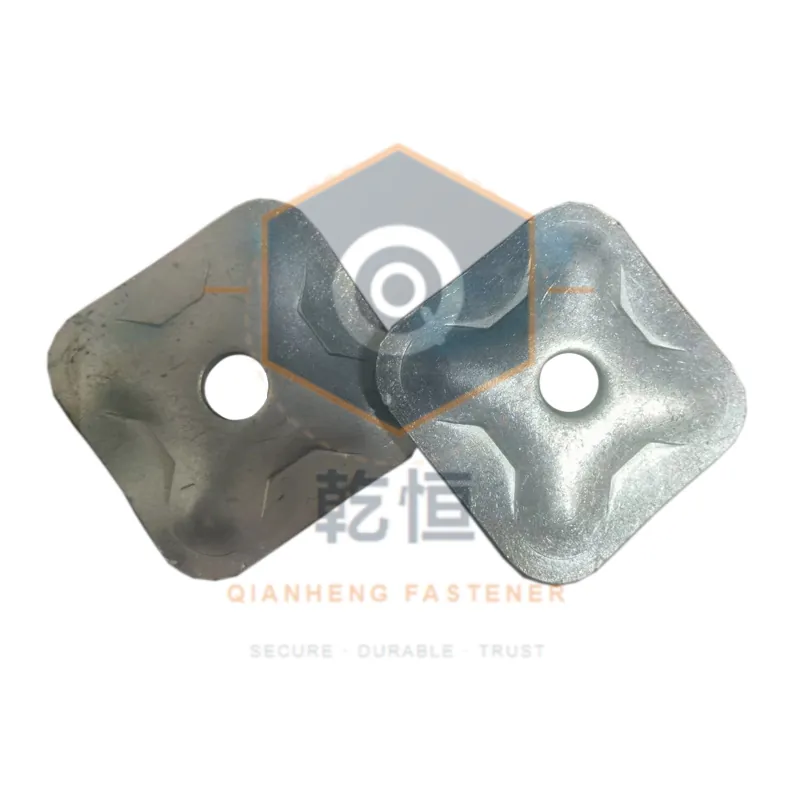
A plum or corrugated washer under the nut does three things: it spreads the load, it provides friction that resists back-off, and it protects the panel or waler face from the nut's rotation. Omitting it is the most common cause of a nut that loosens during vibration and a panel that shifts at the joint.
How tight is right
Formwork ties work in tension, so the nut does not need high torque — it needs full face contact and no play. Practical guidance: tighten by hand until the nut seats, then a further quarter turn with the tool of the system (many systems provide a short wrench for exactly this).
Over-tightening does harm: it crushes timber beams, embeds the nut into the waler, stretches the thread locally, and pre-loads the rod so that the working tension adds to an already high stress. On hot-dip galvanized assemblies over-tightening also galling the thread, which makes removal after the pour difficult.
Reuse checks
Thread fit by hand on a sample per batch — a nut that needs a wrench to run down is already damaged or coated out of tolerance.
Wing or ear deformation, which reduces grip and indicates the nut has been loaded in shear rather than tension.
Bearing face wear on disc nuts, which reduces the contact area and lets the nut embed.
Do not mix nuts from different systems on the same rod even when the thread matches: class, bearing face and wing geometry differ, and the joint capacity is set by the weakest element.