
On a single-sided wall there is no second panel to pull against, so the concrete pressure must be transferred into something else: the foundation, the existing structure, or the ground. Understanding where that reaction goes explains why these systems use so much hardware.
The load path
Concrete pressure pushes the panel outward. The panel transfers load to walers, walers to the bracing frame, and the frame resolves the load into two components: a horizontal component taken by embedded anchors or tie rods cast into the base, and a vertical or inclined component taken by the bracing struts down to a footing or kicker.
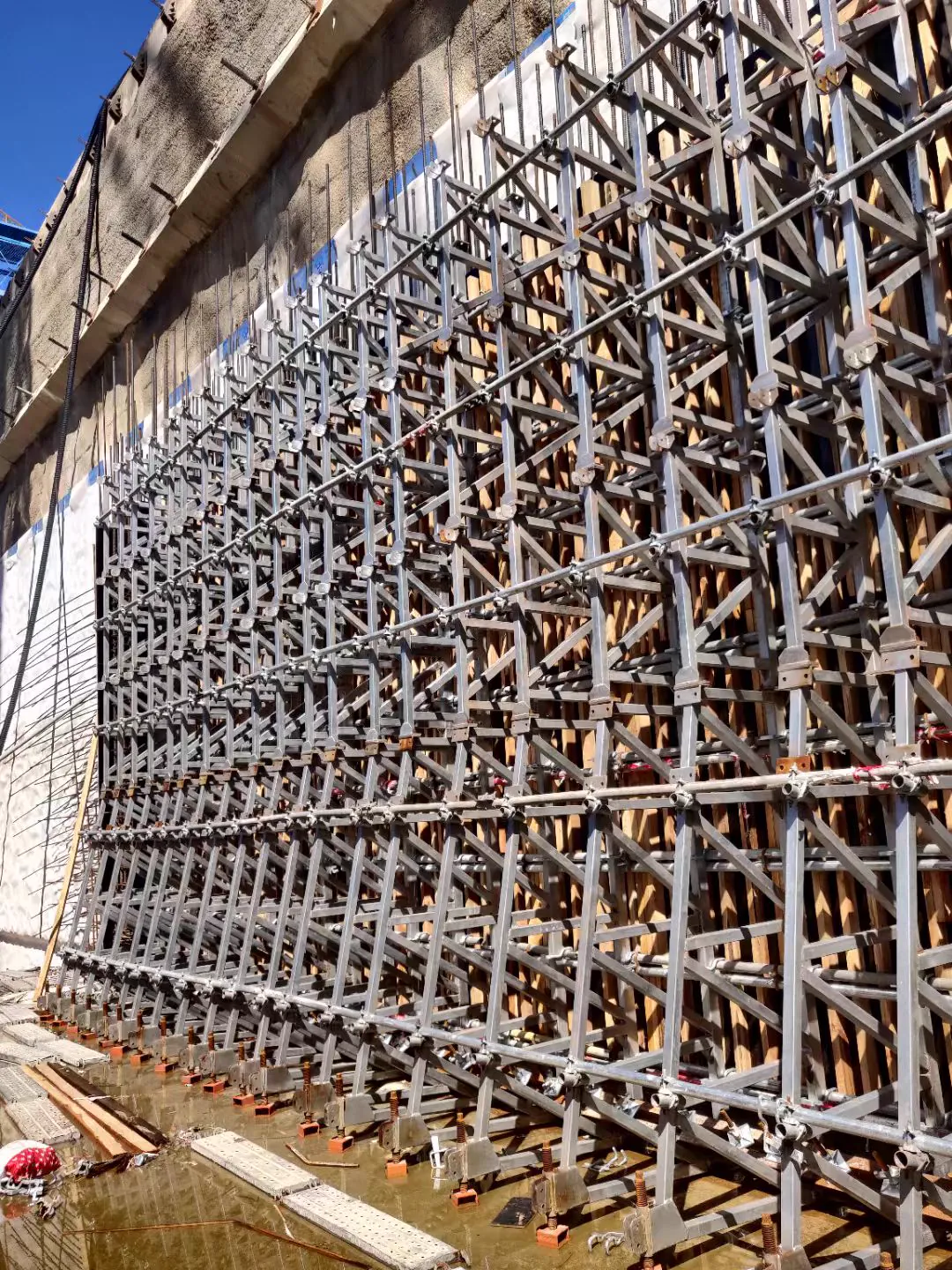
If either path is incomplete, the wall moves: horizontally it slides or overturns; vertically the formwork lifts.
Embedded anchors and their setting
Anchors are cast into the previous lift or into the base slab, and their position and depth are set by a template. Two errors dominate: anchors set at the wrong spacing so the brace frame does not land on them, and anchors not perpendicular to the face, which introduces a bending component the anchor was not designed for.
Where anchors are cast into a fresh slab, verify concrete strength before loading. Formwork loads applied to green concrete are a common cause of anchor pull-out that is later blamed on the anchor.
Bracing and stability
Struts must be braced against buckling in both directions, not only in the plane of the frame. The usual failure is out-of-plane: the frame is stiff in the direction of the pour and unbraced laterally, so it twists and the panel moves diagonally.
Base plates need positive fixing — dowels or cast-in sockets, not friction on a smooth slab. A base plate relying on friction alone is the detail most often found wanting when the pour starts.
Checks before the pour
- Anchor positions and depths verified against the layout drawing with a template record.
- Concrete strength at the anchor locations above the specified transfer strength.
- Strut angles within the design range, and all lateral bracing installed.
- Base restraints installed and tight.
- Tie rods or anchors tensioned as specified, with a sample checked by torque or by feel against an approved reference.
- Pour rate agreed with the concrete crew, and monitored during the pour, since the design assumed a rate.
Procurement points
The hardware set for a single-sided system is anchor, tie or rod, cone, washer, nut and the bracing frame with its connections. Order them as a matched set or verify interchangeability with a gauge. Mixing suppliers on a single-sided system usually shows up as a mismatch at exactly the joint that must carry the reaction.