
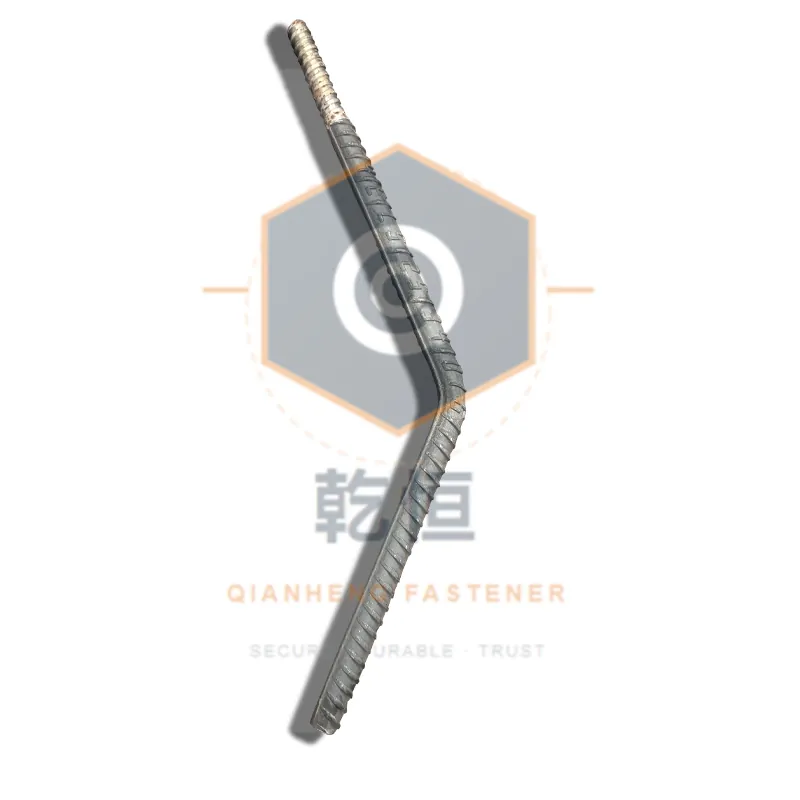
A normal tie works because it is in tension between two faces: the rod pulls, the anchor plates push back on the formwork, and the two cancel. Take one face away and that balance has to be rebuilt somewhere else — in the concrete already cast, in a bracket, or in the ground. This is the situation on a diaphragm wall against an excavation face, a core wall against an existing structure, or a tank where the second face will never be accessible.
The two routes
A single-sided embedded bolt is cast into a previous pour or into a footing, and the new formwork is anchored to it. The bolt carries the pull-out load into the hardened concrete. Nothing passes through the new wall.
A through-tie needs both faces. Where the far face exists but is already built, a through-tie can sometimes be replaced by a bolt anchored into the old concrete, or by a tie welded to an embedded plate. Where the far face is soil or rock, an anchor has to go into the ground instead.
| Criterion | Single-sided embedded bolt | Through-tie |
|---|---|---|
| Faces required | One | Two |
| Load path | Pull-out into hardened concrete or ground | Tension between two formwork faces |
| Hardware recovered | Partly — the outer bar and nuts | Yes — the whole rod |
| Depends on previous pour strength | Yes | No |
| Typical exposure | Diaphragm walls, cores, tank walls, additions | Standard walls and slabs with two accessible faces |
| Main failure mode | Pull-out or edge breakout | Rod yield or anchor plate punching |
Why single-sided work is harder to get right
The load does not disappear; it has to be carried by something that was cast earlier. Three things decide whether the detail holds:
- EMBEDMENT DEPTH AND EDGE DISTANCE — a bolt near an edge can break out a cone of concrete instead of developing its full pull-out capacity. Spacing to the free edge and to the next bolt matters as much as depth.
- STRENGTH OF THE HOST CONCRETE AT THE TIME OF LOADING — if the previous pour has not reached the specified strength, the bolt is being asked to load concrete that is not ready. Curing records matter here, not the calendar.
- ALIGNMENT — an embedded bolt cast out of position cannot be moved. Templates and a check before the pour are the only reliable control.
Sequencing rules that prevent most failures
- Set the bolts with a template rigid enough to hold position during the pour and vibration.
- Check the position after the pour and before the formwork is erected; record it.
- Confirm the host concrete strength from cube or cylinder results before loading the bolts.
- Tighten to a defined torque, not "until it feels right" — an under-torqued bolt lets the panel move, an over-torqued one can strip the thread or crack the concrete locally.
- Load the bolts progressively as the pour rises; the pressure is not uniform and neither should the tightening be.
Where a through-tie is still the better answer
If both faces are accessible, a through-tie is usually cheaper and more forgiving: the load path is simple, the hardware is reusable, and the capacity is easy to verify with a pull test. Single-sided anchorage is chosen because access forces it, not because it is better. On retaining walls against soil where the excavation face is later backfilled, it is worth checking whether a temporary through-tie with a sleeve is possible before committing to embedded bolts.
Pull-out testing
For embedded bolts, a pull-out test on the actual installation is the only direct verification. Test a sample of bolts to the specified load before the pour, keep the records with the pour card, and replace any bolt that has been tested beyond its working load. A bolt that has been proof-loaded is a bolt that has been used.
What to specify when ordering
- Bolt diameter, grade and thread standard, matched to the nuts and plates used with it.
- Embedment depth and the minimum concrete strength required at loading.
- Edge distance and spacing assumed in the design — these must appear on the setting-out drawing, not only in the calculation.
- Whether the bolts are supplied with templates, and whether the template is reusable.
- Surface treatment: bolts that stay in the ground or in a wet environment need protection appropriate to the exposure, and the coating must not reduce thread fit.
For walls that must retain water, the water-stop decision is separate from the anchorage decision — see cast iron water stop nut vs welded plate.