
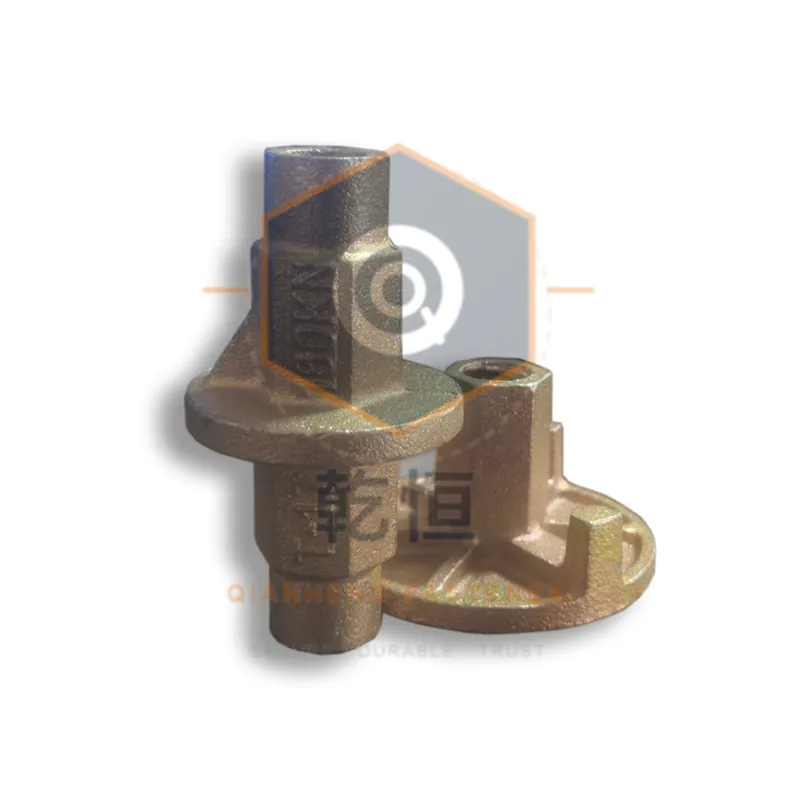
Both details exist to do one thing: force water that is travelling along a tie bar to change direction, so a straight capillary path becomes a long labyrinth. The welded plate is the traditional solution. The cast iron water stop nut is a mechanical alternative that is gaining ground where welding quality is hard to guarantee or wall thickness changes frequently.
How the two details differ
A welded water stop plate is a steel disc, typically 40-100 mm across and 3-5 mm thick, fillet-welded all round to the bar at mid-length. It is fabricated in the workshop with the bar, so the assembly arrives as one piece. Its quality depends entirely on the weld.
A cast iron water stop nut is a cast component that threads onto the bar and is tightened to a defined position, presenting a broad sealing flange to the concrete. It does not require a weld at the bar, and it can be positioned at the point of use.
| Criterion | Welded plate | Cast iron water stop nut |
|---|---|---|
| Sealing geometry | Flat disc perpendicular to the bar | Flanged cast body, larger bearing face |
| Welds on the bar | Required | Not required |
| Position adjustable on site | No, fixed in the workshop | Yes, within the threaded length |
| Wall thickness change | Needs a new bar | Same bar, reposition the nut |
| Skill dependence | Welder and inspection | Torque and correct seating |
| Typical risk | Incomplete or cracked weld | Loose fit or cross-thread |
Why the weld is the weak point of the plate
A plate only seals if the weld is continuous around the full circumference. Common defects seen on site are a plate welded at two or three points instead of all round, a plate cracked by thermal stress in high-carbon bar, and a plate that was welded off-centre so it ends up close to one face. Any of these leaves a path that water will find, and the defect is invisible once the wall is poured.
There is a second issue: welding heat can locally change the properties of a cold-worked or heat-treated bar. On high-strength tie rod this is the reason some specifications require a non-welded water-stop detail or a strictly controlled welding procedure.
Where the cast iron nut earns its cost
- WHEN WALL THICKNESS VARIES — one bar length covers several thicknesses because the nut is positioned on site rather than welded at a fixed point.
- WHEN WELDING INSPECTION IS NOT AVAILABLE — the detail does not depend on a welder's consistency, which reduces inspection burden.
- WHEN THE BAR IS HIGH STRENGTH or coated, and welding would damage the coating or the heat-affected zone.
- WHEN THE PROGRAMME IS TIGHT — no fabrication lead time for welded assemblies; stock bar plus nuts is enough.
Where the welded plate still makes sense
High-volume repetitive work with a fixed wall thickness and a workshop that can weld and inspect consistently will usually find the welded plate cheaper per unit. It also has a longer track record in specifications, and some project documents name a welded plate explicitly — in that case the cast alternative needs engineer approval before it is substituted.
Specification points for either detail
- State the minimum cover to the sealing element from each face; the seal is useless if it sits near the surface.
- State the sealing element dimensions — plate diameter and thickness, or nut flange diameter.
- For welded plates: require a continuous fillet weld all round and a visual or magnetic-particle check before delivery.
- For a cast nut: state the thread standard and the seating torque, and require that the nut is checked for tightness before the pour.
- In both cases, keep the bar clean where the seal sits; oil and mill scale prevent both a good weld and a good seat.
Relationship to the rest of the tie
The water-stop detail is only one part of a watertight penetration. It works together with the five-section rod or embedded bar, the cones or recesses at the faces, and the mortar used to close them. Changing one component rarely fixes a leak that originates in another — see five-section water stop rod vs one-piece embedded rod.