
Formwork Fasteners: The Complete Procurement and Engineering Guide
At a glance: formwork fasteners are a load path, not a parts list. Size the rod to the concrete pressure, specify the material and coating to the environment, match the system to the structure, and confirm the export paperwork before the goods leave the port. Working with fluid concrete under pressure is a recognised site hazard, so the load path is also a safety path — see OSHA's concrete construction eTool for the hazard background.
> In brief > - Material, thread, coating and records — in that order of consequence. > - A fastener is a small part with a long service life. > - The specification is where most of the value is created.
Formwork fasteners hold fresh concrete in shape until it hardens. The buyer's job is not to pick a catalogue number but to confirm that every part in the load path is rated for the pressure the structure will place on it. This guide walks through the system, the materials, the sizing arithmetic, where each part is used, what export compliance requires, and how to write an RFQ that a supplier can actually confirm.
Our own production and test data are available on request — see how our factory works and contact the engineering team for the documents behind any figure quoted here.
Tie rod is the tension member that holds the two form faces together against the fluid concrete pressure. Yield load refers to the load at which the steel begins to deform permanently. Safety factor is the ratio between the rated load and the load the part will actually carry, providing a margin for site variations. Water-stop tie rod means a tie that carries the load and blocks the through-path of water, keeping the wall dry after the form is struck.
1. The product system.
A complete tie-rod assembly is a set of matched parts, and an assembly is only as strong as its weakest element. The rod is rarely the weakest part; the cone, the washer plate or the embedded anchor usually governs.
| Component | Function in the load path | Typical material |
|---|---|---|
| Tie rod (D15 / D20) | Carries tensile load across the wall | Cold-drawn or rolled steel, Q345 class |
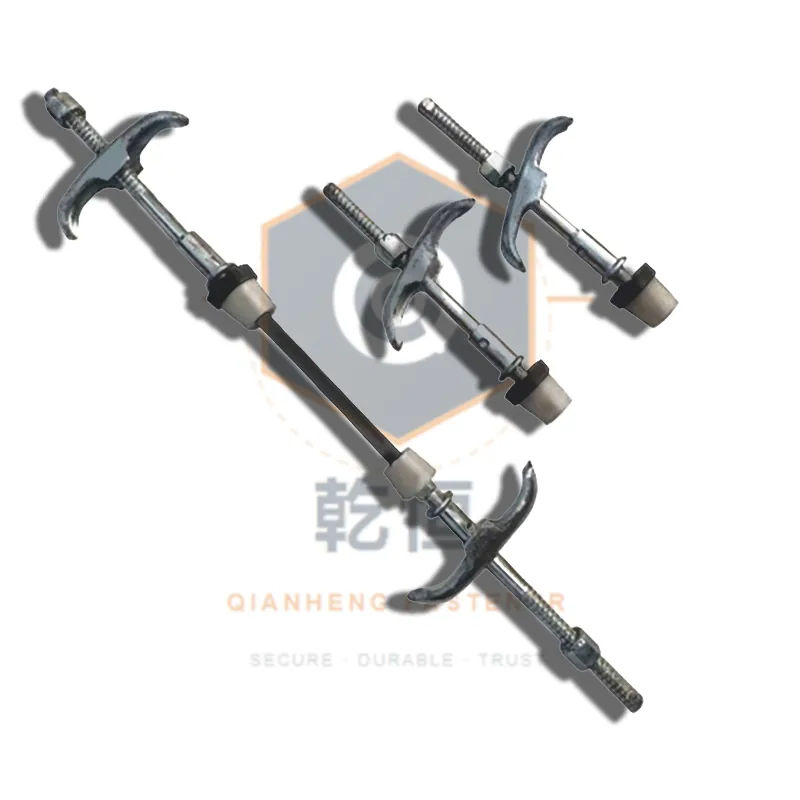
| Water-stop tie rod | Ties the wall and seals the through-point | Steel core with moulded PVC or rubber stop |
| Wing / disc nut | Transfers rod tension into the waler | Cast iron QT450 or forged steel |
| Washer plate / square base plate | Spreads load behind the waler | Mild steel, sometimes galvanized |
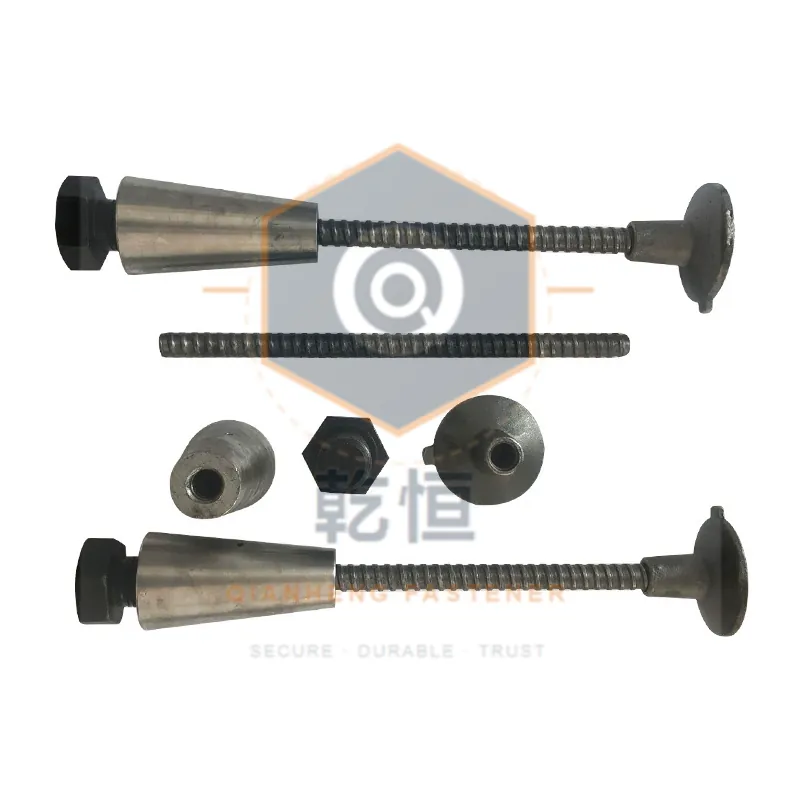
| Climbing cone | Forms the lost-end recess for staged pours | Cast iron |
| Waler (steel waling) | Distributes tie load to the form face | Structural steel section |
| Embedded bolt (single-sided) | Anchors formwork with no through-tie | Threaded steel bar |
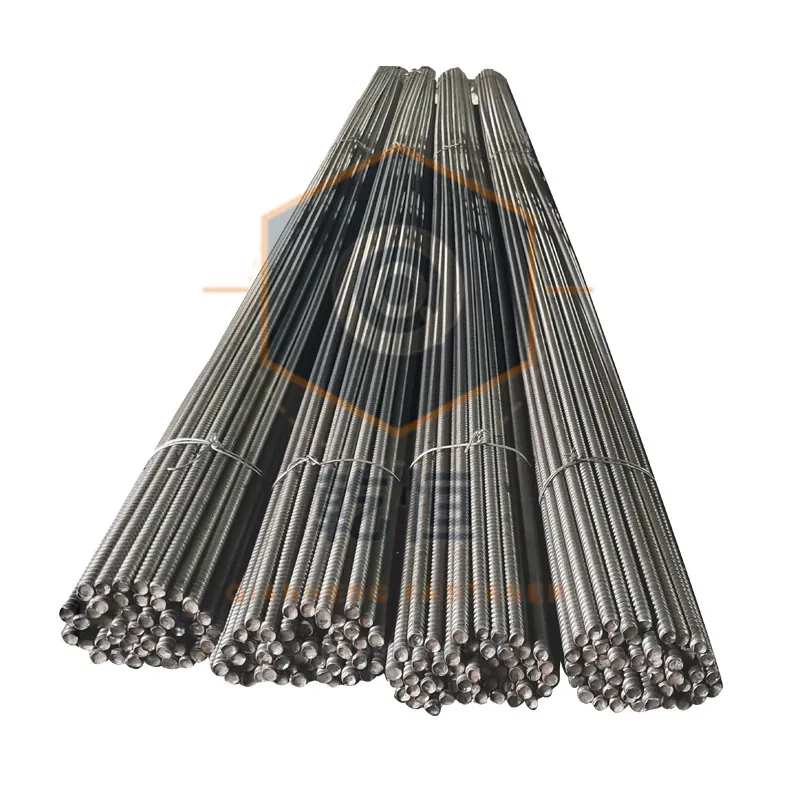
The D15 / D20 high-strength tie rods page lists thread forms and grades alongside these figures, and the three-part water-stop tie rod covers below-grade work.
2. Materials and mechanical limits.
Tie rod is the tension member that holds the two form faces together against the fluid concrete pressure. Yield load is the load at which the steel begins to deform permanently, and it is the figure most datasheets publish for a rod.
Steel grade sets the ceiling. Structural grades Q235 and Q345 cover most rods and nuts; 45# steel, quenched and tempered, is used where higher strength in a smaller diameter is needed. Cast parts such as wing nuts and climbing cones are normally ductile iron QT450, which gives a predictable breaking load rather than a brittle failure. Our team tested every finished part against its specification and measured the actual proof and breaking load, then issued a 3.1 material certificate per batch — the same calibration discipline described by NIST's material measurement standards.
| Surface treatment | Protection level | Typical use |
|---|---|---|
| Hot-dip galvanizing | High, for outdoor and humid sites | Marine, tropical, long storage |
| Dacromet / zinc-flake | Very high, thin and thread-friendly | Pre-assembled nuts and cones |
| Black oxide | Low, cosmetic only | Indoor or short-life temporary works |
As an indication from our own datasheets, a D15 system is commonly rated near 150 kN in yield terms and a D20 near 230 kN. Those are yield figures; divide by the project safety factor, commonly 2 to 3, before comparing with the calculated load per tie. The cast-iron water-stop nut we produce in QT450 is rated to a documented breaking load and supplied with the test result.
Standard basis: EN 14399-1
3. Sizing the tie: pressure to spacing.
Safety factor is the ratio between the rated load and the load the part will actually carry; it is the margin that absorbs the difference between the calculation and the real site.
Lateral pressure is generated by fluid concrete before it stiffens and never exceeds full hydrostatic pressure. A safe first estimate is density times height: normal reinforced concrete weighs about 24 kN/m3 (see Engineering Toolbox concrete properties), so a 3 m lift gives roughly 75 kPa at the base. Real pressure is lower when the pour is slow or the concrete is warm, but the hydrostatic figure is the conservative ceiling to start from. The ACI 347 formwork practice takes the same hydrostatic starting point before applying the temperature and pour-rate redutions.
Each tie supports the pressure on its tributary area, which for a regular grid is the horizontal spacing times the vertical spacing.
| Pressure at base | Spacing 0.8 x 0.8 m | Spacing 1.0 x 1.0 m | Spacing 1.2 x 1.2 m |
|---|---|---|---|
| 50 kPa | 32 kN | 50 kN | 72 kN |
| 75 kPa | 48 kN | 75 kN | 108 kN |
| 100 kPa | 64 kN | 100 kN | 144 kN |
Worked example: a 3 m lift at 75 kPa, grid 1.0 x 1.0 m, gives 75 kN per tie. Against a D15 rated near 150 kN yield and a safety factor of 2, the allowable working load is about 75 kN, so the D15 is at its limit and a D20 would be the safer choice. The climbing cone assembly and the square base plate must be checked on the same basis, because the cone or the plate often governs before the rod does.
Consider a faster pour on the same wall: a higher pour rate keeps the concrete fluid longer and raises the effective pressure, so the same D15/D20 choice should be re-checked rather than copied from a previous job.
Standard basis: ISO 898-1 — Mechanical properties of fasteners made of carbon steel
4. Where they go: application map.
- Residential and commercial buildings: standard walls and columns, mostly D15 with regular spacing.
- Bridges, viaducts and tunnels: high lifts and heavy sections, D20 with closer spacing; below-grade segments need a water-stop tie.
- Basements and pools: a water-stop tie rod refers to a tie that carries the load and blocks the through-path of water at the same point, so the wall stays dry after the form is struck. The five-section type lets the lost ends be removed and the remaining core capped.
- Single-sided formwork: no through-tie is possible, so an embedded bolt anchors the face to the substrate.
For example, a basement car park with a 4 m retained height will need a water-stop tie at every through-point and a D20 rather than a D15. The hydrostatic pressure at 4 m is well above the 3 m case used above.
5. Compliance for export: EAC, GOST-R, CE.
For the Eurasian Economic Union the conformity route is decided by the product, not by preference. The practical routes resolve into three outcomes. The certificate is normally held by the importer or its authorised representative inside the EAEU, not by the factory, which is why the timeline belongs to the buyer.
| Route | What it is | Typical trigger |
|---|---|---|
| EAC certificate or declaration | Conformity under EAEU technical regulations | Higher strength classes, load-bearing use |
| GOST-R declaration or certificate | Russian national assessment where union rules do not apply | General-purpose fasteners above the small-size threshold |
| Exemption letter | Official statement that the product is outside mandatory scope | Small non-load-bearing hardware |
If the same goods are also placed on the EU single market, the EU Construction Products Regulation sets a separate CE/CPR conformity route. The technical file the manufacturer controls is the part that removes delay in every route: a material certificate to EN 10204:2004 3.1, tensile and proof-load test data, coating specification, and an ISO 9001:2015 certificate. Our EAC and GOST-R article goes through the document pack a Russian buyer will ask for.
6. Procurement practice.
State the four real inputs in the RFQ: height of the lift, pour rate, concrete temperature at placement, and intended tie spacing. With those, capacity is confirmed against the actual duty rather than a catalogue page.
We hold about 300 t of fasteners in stock and dispatch stock items within 3 days; custom diameters, lengths and coatings run 7 to 15 days. Every finished part is tensile-tested against its specification and the result travels with the batch. Trade terms are EXW, FOB, CIF or DDP depending on who controls the freight, and export packing uses VCI paper and strapped crates to prevent rust in transit. Each specification is reviewed by our quality engineer before release.
Consider a first order into a new market: agreeing the conformity route and the technical file with our engineering team before production starts avoids the rework that arrives when paperwork is left to the last week.
FAQ.
Which rod diameter should I specify, D15 or D20?
Match the diameter to the calculated load per tie, not to habit. A D15 system is commonly rated near 150 kN in yield terms and a D20 near 230 kN, so D20 is chosen for high lifts, fast pour rates and heavy sections, while D15 covers standard walls and columns. Always compare on the same basis, yield load divided by the project safety factor.
Do I need EAC certification for every shipment to Russia?
No. The route depends on strength class, use and customs code; a large share of ordinary fasteners falls outside the mandatory EAC scope and needs a GOST-R declaration or an exemption letter instead. The certificate is normally held by the importer or its authorised representative inside the EAEU, not by the factory.
What should the RFQ state so the supplier can confirm capacity?
Give the four real inputs: height of the lift, pour rate, concrete temperature at placement, and intended tie spacing. With those, capacity is confirmed against the actual duty rather than a catalogue page, and any mismatch between the rod and the rest of the assembly is caught before the pour.
---
About the author — Qianheng's formwork engineering team designs and tensile-tests tie-rod systems for contractors across the EAEU, the Middle East and Southeast Asia. *Reviewed by our quality engineer before release.*
References and standards.
- EN 10204:2004 — Types of inspection documents
- ISO 898-1 — Mechanical properties of fasteners made of carbon steel
- ISO 3501 — Corrosion resistance of stainless steel fasteners
- NIST material measurement standards
- EN 13670 — Execution of concrete structures
- ACI 347 — Guide to formwork for concrete
About us: This article covers formwork fasteners, including tie rods, water-stop systems, and accessories, and is checked against our production and test data. Our factory capabilities include manufacturing and testing to international standards. Our contact page provides access to the engineering team for detailed inquiries, and the about page documents our production processes. This article was reviewed by the Qianheng Formwork Engineering team.