
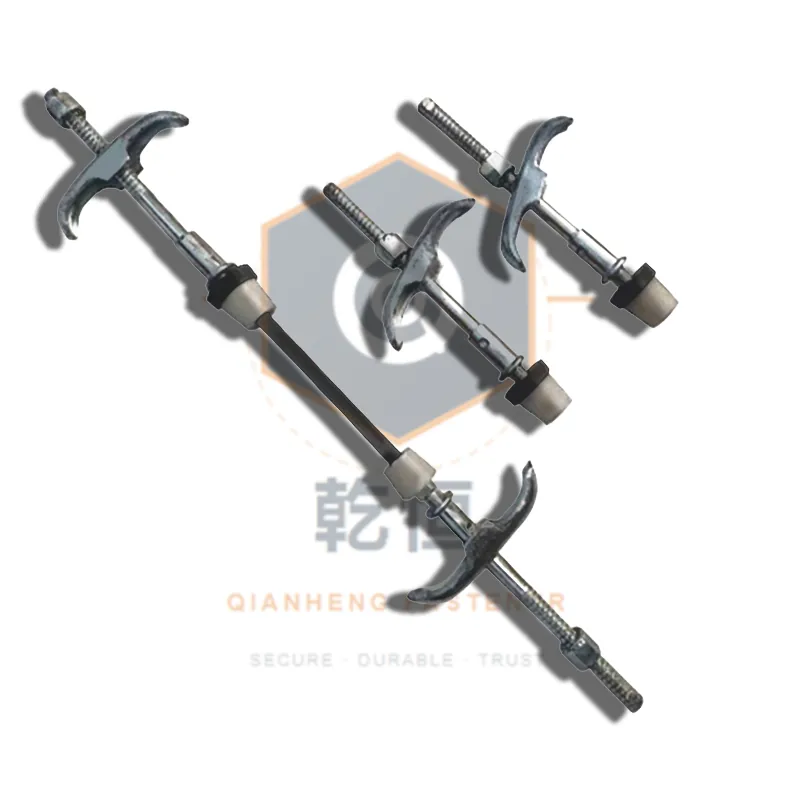
For basements, tanks, tunnels and reservoirs the tie cannot pass all the way through and be withdrawn — a through hole is a leak path. Two families solve this: the one-piece embedded bar (sometimes called a lost-end or through-wall water stop rod) and the five-section water stop tie rod. Both leave steel in the wall on purpose. The economics and the sealing mechanism are different.
What each system actually is
A one-piece embedded rod is a single bar cut to wall thickness, with one or more water-stop plates welded at mid-length. The bar ends are threaded so a nut and anchor plate can clamp the formwork from outside. When the pour is stripped, the protruding ends are cut back and covered; the entire bar stays in the wall.
A five-section rod splits the same job into five parts: two reusable outer threaded bars, two plastic or steel cones at the faces, and one short embedded middle bar carrying the welded water-stop plate. After stripping, the outer bars are unscrewed from the cones and used again on the next pour. Only the middle section is consumed.
| Item | One-piece embedded rod | Five-section water stop rod |
|---|---|---|
| Parts consumed per tie | 1 bar (full wall length) | 1 short middle bar + 2 cones |
| Reusable hardware | None | 2 outer bars |
| Sealing element | Welded plate(s) on the bar | Welded plate + cone seat at each face |
| Cut-back work after stripping | Yes, both faces | Minimal — cones leave a formed recess |
| Suits very thick walls | Yes | Yes, middle bar is made to length |
| Failure mode if plate weld is poor | Leak along the bar | Leak along the bar |
Where the cost difference comes from
On a high wall, the embedded length dominates. A one-piece rod for a 500 mm wall consumes 500 mm of threaded bar per tie position; the five-section version consumes the middle bar only — typically 150-250 mm depending on cone depth — while the two outer bars rotate through hundreds of pours.
That difference is why the multi-section design is standard on projects with repetitive wall pours: the consumable per tie drops, and so does the weight the crew handles on each cycle. On a one-off structure with a handful of tie positions, the extra SKUs and assembly steps are rarely worth it, and a simple one-piece bar is cheaper to buy and simpler to fit.
The seal is the same physics in both cases
Neither design seals because the rod is special. Both seal because a plate welded across the bar forces any water travelling along the steel/concrete interface to take a longer path around the plate — a labyrinth rather than a straight capillary. Three conditions decide whether that works:
- The plate must be continuously welded all round, not tack-welded at two points. A gap on one side is a straight leak path.
- The plate must be centred in the wall section. A plate that ends up near one face leaves too little cover on that side and the concrete can spall around it.
- The bar surface where the plate sits must be clean of oil and mill scale before welding.
If any of these fail, changing from one-piece to five-section will not fix the leak. The failure is at the weld, not in the section count.
Recess treatment at the faces
The two systems leave different surface conditions. A one-piece rod leaves cut bar ends that must be recessed and patched with mortar — a common defect point, because a shallow recess lets the cut end rust, swell and pop the patch. The five-section design leaves a formed conical recess from the cone; these are cleaned, filled with mortar or fitted with a sealing cap. Both need the recess to be dry, sound and filled with a shrinkage-compensated mortar, not a dry pack pushed in by thumb.
How to choose
Choose a five-section rod when the pour sequence repeats many times over the same wall thickness, when the crew has to move fast, and when the structure is tall enough that a reusable outer bar saves real material. Choose a one-piece embedded rod when there are few tie positions, when the wall thickness varies a lot from pour to pour, or when the site stores and issues only one bar type.
Where the specification requires a cast-iron water stop nut instead of a welded plate, the decision moves to the nut/plate interface — see cast iron water stop nut vs welded plate.
What to ask your supplier
- Wall thickness and the exact embedded length required, including cover each side.
- Plate diameter, thickness and whether the weld is full-penetration all round.
- Whether the outer bars are supplied with the rods or separately, and their thread standard.
- Test certificate for the bar and, where the specification calls for it, a pull-test result for the assembly.
- Whether the cones are matched to the bar diameter — mixing diameters is a common site error.
For the reusable through-wall alternative where the wall does not need to retain water, see reusable through-tie vs lost-end tie.