High-Rise and Bridge Tie Rod Selection: Loads, Staged Pours and Climbing Systems
At a glance: tall buildings and bridges load the tie rod more heavily than a standard wall, because high lifts and pour rates elevate the load per tie while a safety-critical core permits no tolerance for a weak link. Dimension the assembly against the actual pressure and grid, select D20 with closer spacing at scale, and utilise climbing cones for staged pours so the load path remains rated at every lift. Working with fluid concrete under pressure is a recognised site hazard, so the load path functions simultaneously as a safety path. See OSHA's concrete construction eTool for the hazard background, and the EU construction-products framework for the conformity context.
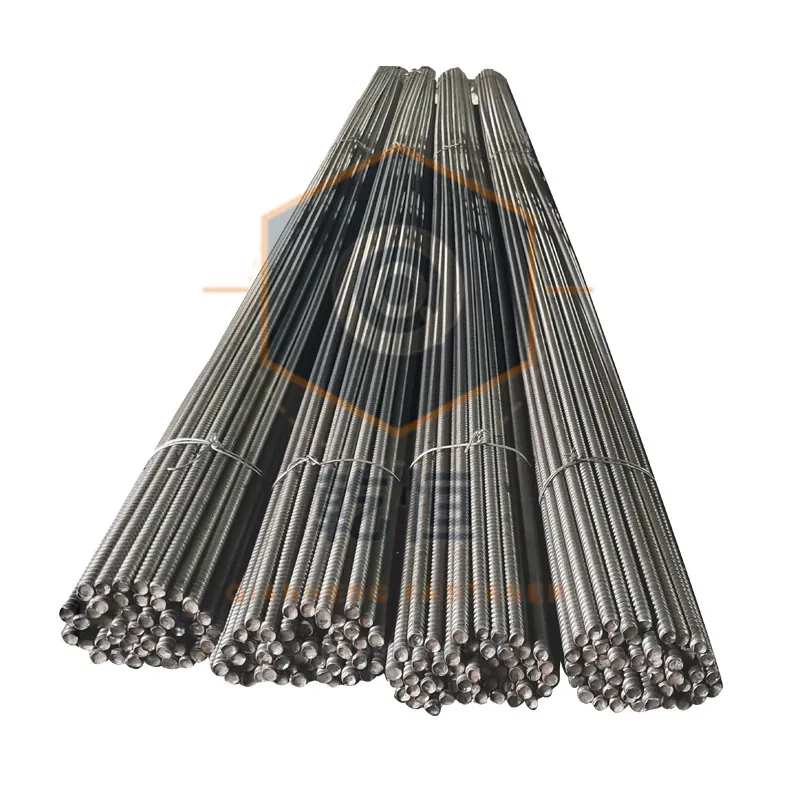
High-rise cores, bridge piers and viaduct segments are precisely where tie-rod selection transitions from a routine exercise into an engineered specification. This guidance examines the loads encountered at height, explains why D20 prevails at scale, describes how staged pours utilise climbing cones, and reviews the tolerances and coatings that withstand the site environment.
Tie rod is a component that secures formwork against the lateral pressure of concrete during pouring. Pour rate refers to the velocity at which concrete is introduced into the form, affecting the fluid state and lateral pressure. Climbing cone means the cast-iron component that forms the lost-end recess in staged pours, allowing the form to be climbed and re-tied. Safety factor is the ratio used to ensure the working load of a tie rod is below its yield strength, providing a margin of safety. Hydrostatic pressure means the pressure exerted by a column of fluid, in this case, the weight of the concrete multiplied by the lift height.
1. Why scale changes the choice.
A standard wall is poured in a modest-height lift at a moderate rate, whereas a high-rise core is poured in tall lifts with a continuously operating pump. A bridge pier constitutes a heavy section that cures slowly under sustained structural load, and both conditions elevate the pressure the tie experiences.
Pour rate represents the velocity at which concrete is introduced into the form, and a faster rate maintains the concrete in a fluid state for a prolonged duration while elevating the effective lateral pressure prior to stiffening. A high lift superimposes hydrostatic head above that effect, which explains why a core that performed adequately with D15 on a low wall can become under-rated when assessed at D20 scale.
2. Load at height: the arithmetic.
Lateral pressure never exceeds the full hydrostatic value, which equals the concrete density multiplied by the vertical lift height. Normal reinforced concrete weighs approximately 24 kN/m3 (see Engineering Toolbox concrete properties), so a 4 m lift yields approximately 96 kPa and a 6 m lift approximately 144 kPa at the base. A rapid pour rate subsequently drives the actual pressure toward that theoretical ceiling.
| Lift height | Hydrostatic base | Load at 1.0 x 1.0 m | D15 work (SF 2) | D20 work (SF 2) |
|---|---|---|---|---|
| 3 m | 72 kPa | 72 kN | 75 kN | 115 kN |
| 4 m | 96 kPa | 96 kN | 75 kN | 115 kN |
| 6 m | 144 kPa | 144 kN | 75 kN | 115 kN |
Worked example: a 6 m core lift at 144 kPa, with a grid of 1.0 x 1.0 m, yields 144 kN per tie. The D15 working load at a safety factor of 2 is approximately 75 kN, which lies far below the duty, while the D20 at approximately 115 kN remains insufficient for that grid. The resolution is therefore to tighten the grid to 0.8 x 0.8 m (about 92 kN) or to reconsider the safety factor. The square base plate and climbing cone assembly are subsequently verified on the identical basis.
Standard basis: EN 13670
3. D20 and closer spacing at scale.
For tall and heavy sections the practical resolution is D20 with a tighter grid. The D20 system is commonly rated near 230 kN yield against the D15 near 150 kN, so at a high lift the D20 retains margin after the safety factor, whereas the D15 falls below the duty.
| Choice | At 4 m / 1.0 m grid | At 6 m / 1.0 m grid | At 6 m / 0.8 m grid |
|---|---|---|---|
| D15 | 75 kN work vs 96 kN | Under-rated | Under-rated |
| D20 | 115 kN work vs 96 kN | 115 kN vs 144 kN | 115 kN vs 92 kN |
The ACI 347 formwork practice adopts the same hydrostatic starting point before applying temperature and pour-rate reductions, so the table above is the conservative ceiling from which to detail. Our D15 / D20 high-strength tie rods page lists grades and thread forms alongside these figures. The same calibration is recorded to NIST's material measurement discipline, with our verification methodology applying batch tensile testing to every finished part.
4. Staged pours and climbing cones.
A staged pour constructs the wall in vertical lifts rather than one full-height placement, so no single placement encounters the full-height pressure. A climbing cone is the cast-iron component that forms the lost-end recess at each stage, permitting the form to be climbed and re-tied without abandoning a full-length rod.
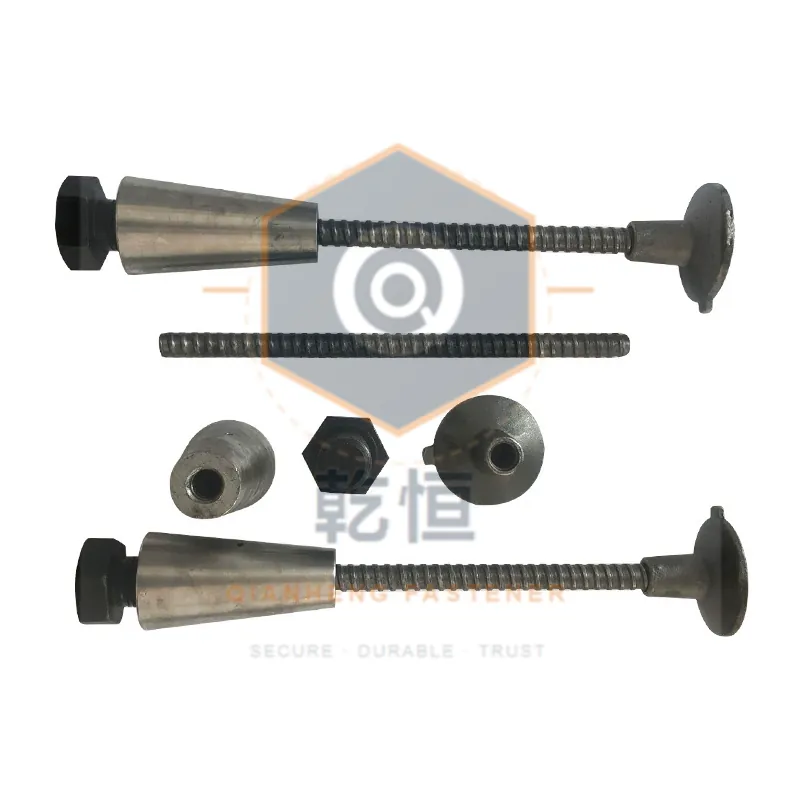
Staging maintains the pressure on each lift within the rod's rated envelope and preserves the load path as continuous and rated at every step. For bridges and cores this constitutes the standard methodology for remaining inside the D20 envelope without an uneconomic grid. The cone and the plate at each stage must be rated to the identical duty as the rod, because the cone frequently governs before the rod does.
5. Tolerances and coating that survive the site.
Outdoor and marine structures require a coating that outlasts the projected service life. Hot-dip galvanizing delivers substantial protection for outdoor and humid sites, whereas Dacromet or zinc-flake delivers exceptional protection within a thin, thread-friendly layer suited to pre-assembled nuts and cones.
| Exposure | Recommended coating | Why |
|---|---|---|
| Marine / tropical | Hot-dip galvanizing | Thick, durable barrier |
| Pre-assembled nuts/cones | Dacromet / zinc-flake | Thin, protects threads |
| Indoor / temporary | Black oxide | Cosmetic only |
Thread and dimensional tolerance determine whether parts actually assemble on site under load. Our cast nuts and cones are produced in ductile iron QT450 for a predictable breaking load rather than a brittle failure, and every finished part is tensile-tested and supplied with the result. Coating is specified to EN 10204:2004 3.1 traceable data, the same calibration discipline described by NIST's material measurement standards.
Standard basis: EN 14399-1
6. Procurement practice.
State the four real inputs in the RFQ — lift height, pour rate, concrete temperature and tie spacing — and for scale add the exposure and the staging intent, because both alter the part the supplier must confirm.
We hold approximately 300 t of fasteners in stock and dispatch stock items within 3 days, while custom diameters, lengths and coatings require 7 to 15 days. Every finished part is tensile-tested against its specification, with the result travelling with the batch. Trade terms are EXW, FOB, CIF or DDP depending on who controls the freight, and export packing utilises VCI paper and strapped crates to prevent transit corrosion. Each specification is reviewed by our quality engineer before release.
For a tall or heavy structure, agreeing the lift height, pour rate and exposure with our engineering team before the first placement prevents the rework that arises when the rod is identified as under-rated at the third lift.
FAQ.
Why does a high-rise core need D20 rather than D15?
Tall cores are poured in high lifts with a fast pour rate, and both raise the load per tie. A D15 system is rated near 150 kN yield and a D20 near 230 kN; dividing by safety factor of 2 to 3, the D15 working load at a high lift is below the duty while D20 retains margin. The core is also a safety-critical element, so the larger margin is the normal choice.
What is a staged pour and why use a climbing cone?
A staged pour constructs the wall in vertical lifts rather than one full-height placement, so the concrete pressure on any single lift remains manageable. A climbing cone forms the lost-end recess at each stage so the form can be climbed and re-tied without abandoning a full-length rod, which keeps the load path rated at every stage.
How do I specify tie rods for a bridge pier?
State the lift height, pour rate, concrete temperature and tie spacing, together with the exposure (marine, freeze-thaw, de-icing). For exposure, specify hot-dip galvanizing or Dacromet and confirm the grade and tolerance; for the load, confirm D20 with closer spacing against the actual pressure and grid, and check the cone and plate on the same basis.
---
About the author — Qianheng's formwork engineering team designs and tensile-tests tie-rod systems for contractors across the EAEU, the Middle East and Southeast Asia. *Reviewed by our quality engineer before release.*
About us: This article covers tie-rod selection for high-rise and bridge construction, checked against engineering standards and practical site requirements. We maintain a stock of 300 t of fasteners and dispatch within 3 days. Our contact page provides direct access to our engineering team for specific project inquiries, and the about page documents our capabilities and quality processes. This article was reviewed by the Qianheng Formwork Engineering team.