
Cold weather changes four things at once: concrete sets more slowly, lateral pressure stays higher for longer, striking times extend, and high-strength steel becomes less forgiving of impact. Each change has a hardware consequence.
Pressure stays high
Because the lower concrete has not gained strength, the pressure curve does not flatten as early. In practical terms, a pour that would reach its hydrostatic-equivalent height at 2.2 m in summer may behave closer to full hydrostatic at 5 °C. Tie spacing calculated for a summer pour can therefore be inadequate in winter even at the same pour rate.
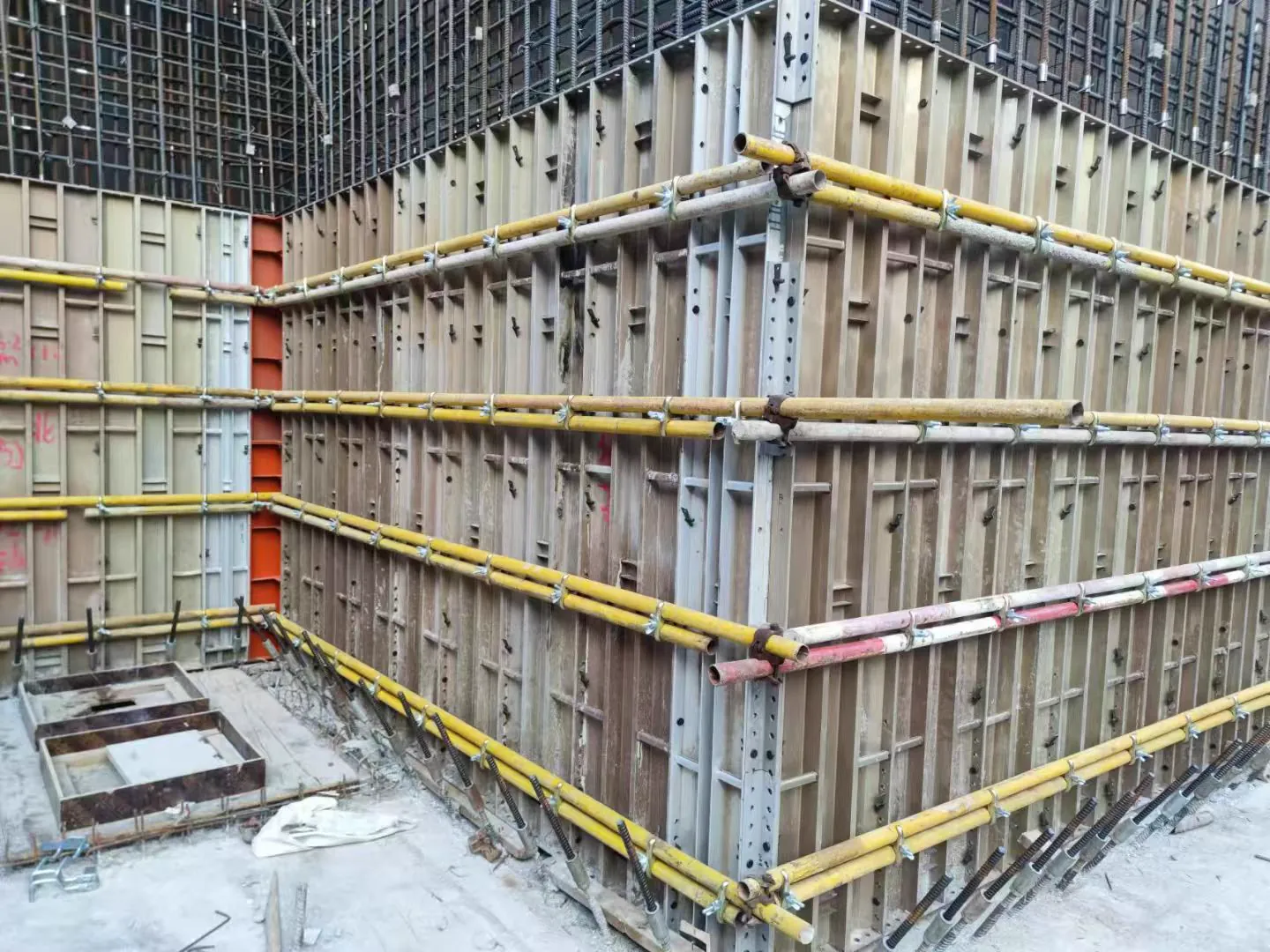
The practical responses: reduce pour rate, reduce tie spacing in the lower zone, or both. If the layout cannot be changed, the pour rate must be, and the decision belongs before the pour starts.
Maturity and striking time
Concrete strength gain is a function of time and temperature, so cold concrete reaches the same strength at a later date. Striking on a fixed timetable in winter is the most common cause of edge spalling around cones and tie positions. Either use a maturity method, or test cubes cured alongside the pour, or extend the striking time by a defined factor and record the decision.
Tie release and handling
Frozen or stiff release agent, concrete bonded to cone surfaces and thread contamination from wet gloves all make cone extraction harder. More force is then applied at the cone, and the concrete edge — which is weaker at that age — pays for it.
Practical steps: keep release agent above freezing, cover cones and the top of the formwork against rain and snow where practicable, clean and re-oil rods immediately after striking, and store rods under cover rather than in a wet stillage.
High-strength steel at low temperature
Carbon and alloy steels lose ductility as temperature falls, and the effect is more pronounced at higher strength classes. A class 10.9 or 12.9 part that would deform on impact at 20 °C can crack at -10 °C. Handling damage — dropped rods, hammered nuts, impact from frozen material — becomes more consequential.
Practical control: avoid shock loading during assembly, do not hammer nuts or cones into place, and inspect more frequently rather than less in cold cycles, because damage initiates as a crack rather than a bend.
Coating and storage
Galvanized and plated surfaces are less reactive when cold and dry, but condensation is a bigger risk: cold metal brought into a warm, humid space will sweat. Rods moved from an unheated container into a heated site hut should be allowed to reach ambient temperature before unpacking, or wrapped so condensation forms on the wrap and not on the parts.
What to document in winter
Pour rate actually used, concrete temperature at placement, ambient temperature record, striking date and method for judging strength, and any inspection findings on the hardware. When something goes wrong in a cold pour, that record is what distinguishes a design issue from a practice issue.