
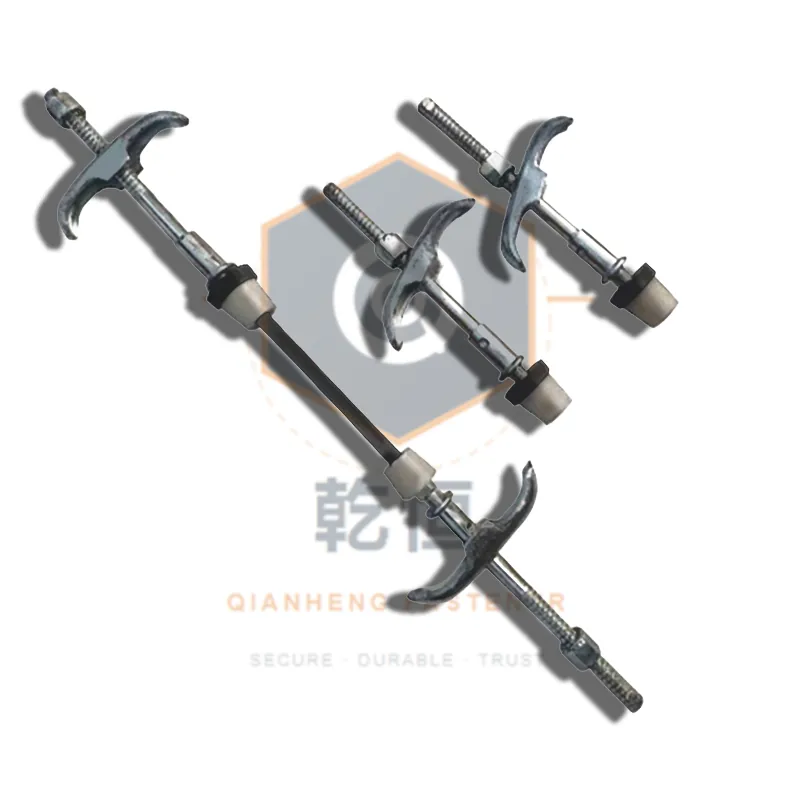
A conventional tie rod leaves a continuous hole through the wall. Water travels along it by capillary action and, where there is hydrostatic head, by pressure-driven flow. Grouting reduces the path but does not eliminate it: grout shrinks, bonds imperfectly at the interface, and has no mechanical anchorage to the concrete.
The mechanism
A water stop tie rod interrupts the path in two places. A steel plate welded to the rod, sized larger than the tie hole and positioned within the wall thickness, forces water travelling along the rod-to-concrete interface to detour around it — a detour that requires breaking the bond on both faces and travelling radially outward far beyond the original annulus. In addition, the middle section stays embedded, so there is no through-hole at all.
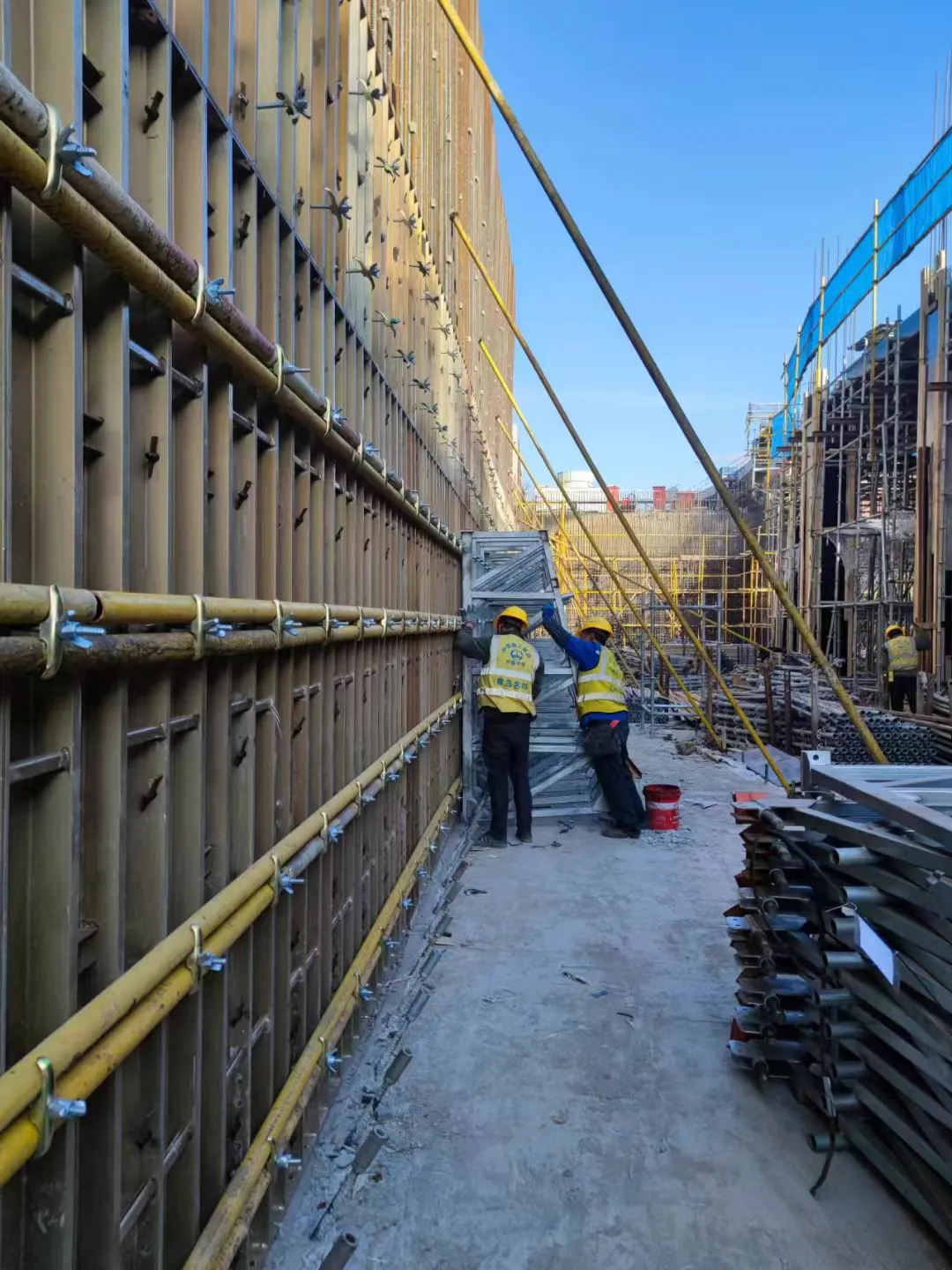
In the five-section design, the outer sections connect to the middle through tapered cones. After the concrete sets, the outer sections and cones are removed and the cone-shaped recesses are filled with mortar. The permanent result is a wall with only shallow surface repairs and a coated plate embedded at mid-depth.
What must be true for it to work
- The plate must be continuously welded, or at least seal-welded on the water side. A tack-welded plate leaks at the tacks and is worse than no plate because it hides the defect.
- Plate diameter must exceed the practical path around it — commonly 80-120 mm on a D15 or D20 rod. Undersized plates give water a short radial route.
- The plate must sit near mid-thickness, not against the formwork face. Near the surface, water can travel around it inside the cover zone.
- The embedded middle section must not be greased or oiled. Release agent smeared onto the embedded bar creates exactly the interface film the plate is meant to defeat.
- Cone recesses must be filled with shrinkage-compensated mortar, not a cement slurry brushed on by hand.
- Cover to the plate must meet the durability requirement for the exposure class, otherwise the plate itself becomes the corrosion path.
Testing and acceptance
Hydrostatic leak tests on basements and tanks are normally run after the recesses are filled and cured. Common acceptance criteria are no visible seepage and total loss below a specified volume over a set period. Where a tie hole weeps, the repair is not a surface smear: chase out the plug, re-fill with a crystalline or epoxy-modified mortar, and re-test.
Where the detail is not needed
Above-ground walls, columns and temporary structures without water exclusion requirements do not justify the extra cost. The detail pays for itself in basements, tanks, pools, tunnels, metro stations and retaining walls below the water table.
Procurement points
Order rod, cone, wing nut and washer as one matched set. The cone taper controls whether the outer section releases cleanly; mismatched cones either seize or leave an oversized void. Specify the plate material and coating, and require the welding procedure and inspection method on the purchase order — a galvanized plate on a bare rod is a common inconsistency.