
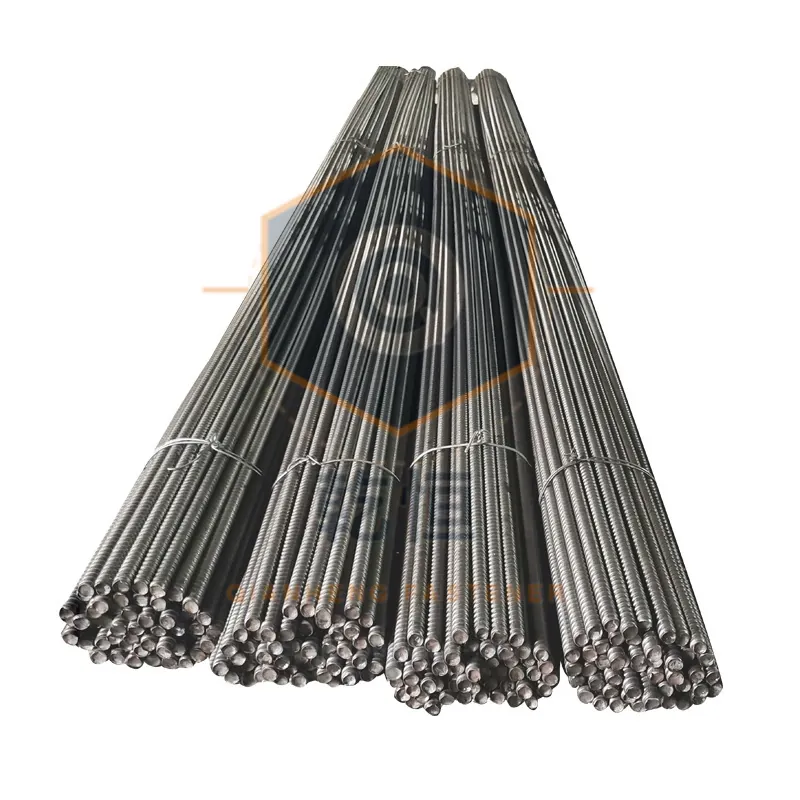
A thread designation carries four pieces of information: the system, the nominal diameter, the pitch, and the tolerance class. Reading it correctly prevents the most expensive formwork mistake there is — ordering rods and nuts that do not mate.
The four systems you will meet
METRIC (ISO 60°): written M20 × 2.5, meaning 20 mm nominal diameter and 2.5 mm pitch. Coarse pitches are the default; fine pitches such as M20 × 1.5 are used where vibration loosening or thin-wall sections matter. Dominant in Europe, China, the Middle East and most of Asia.
UNC / UNF (Unified, 60°): written 1/2-13 UNC, meaning 1/2 inch nominal with 13 threads per inch. UNC is coarse, UNF is fine. Common on North American equipment, older climbing systems and US-sourced props.
WHITWORTH (BSW/BSP, 55°): still found on legacy UK and Commonwealth scaffolding and on pipe threads. The 55° flank angle is not interchangeable with 60° systems even at the same nominal size.
TRAPEZOIDAL (Tr): a 30° thread used for power transmission rather than fastening — jacking screws, high-axial-load tie rods, some climbing spindles. Written Tr 40 × 7.
Why mixing systems fails
Two threads only mate when system (flank angle), diameter, pitch and tolerance class all agree. A 1/2 inch UNC nut on an M12 rod will start by hand and then bind: the flank angles differ by 5°, so contact occurs on a line instead of a surface. Torque rises, galling starts, and either the nut seizes or the thread strips under load.
Partial engagement is the dangerous case, because it can hold at low load and let go when the pour adds pressure.
Checks before ordering
- Measure pitch, not just diameter. Use a pitch gauge, or measure ten pitches with a caliper and divide. Diameter alone cannot separate M12 × 1.75 from M12 × 1.25.
- Confirm tolerance class. 6g/6H is the general-purpose metric pairing; 4g/4h is tighter and less tolerant of coating thickness. Hot-dip galvanizing adds 45-85 µm per flank, enough to make a tight-class nut unusable — galvanized assemblies normally use 6g/6H or a tapped-oversize nut.
- Order rod and nut as a matched set from one source when the joint is safety-related. If they come from different suppliers, put the standard and class in writing on both purchase orders.
- Check the thread form on the drawing. Rolled threads outperform cut threads for fatigue because grain flow follows the profile instead of being severed.
Quick reference
Metric coarse: M10 × 1.5, M12 × 1.75, M16 × 2.0, M20 × 2.5, M24 × 3.0. Unified coarse: 1/2-13, 5/8-11, 3/4-10, 1-8. Formwork tie rods use DW15 (15 mm root, 17 mm OD, 7.5 mm pitch) and Rd20 in metric markets; inch-pattern systems appear mainly on imported climbing hardware.
A five-minute gauge check at goods-in is cheaper than a stopped pour.