
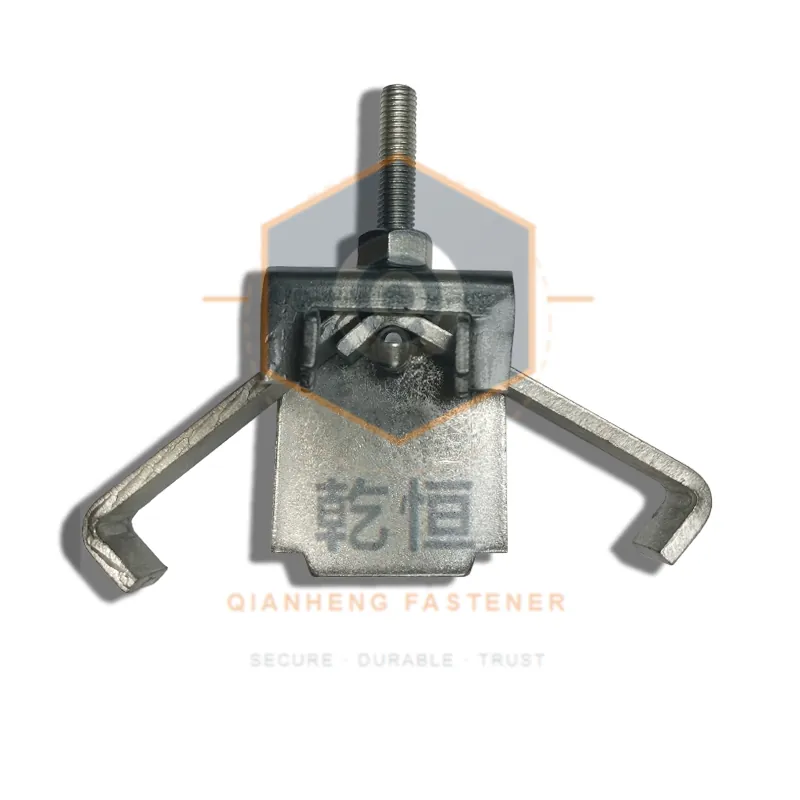
A timber beam claw connector — sometimes called a beam claw, flange claw or H20 clip — is a small stamped or cast fitting that solves one specific problem: holding an H20 timber beam against a formwork panel or steel waling without putting a single hole or screw into the beam. On a large-area wall gang form, a crew installs hundreds of them per panel, so the details that matter are speed, grip and cycle life.
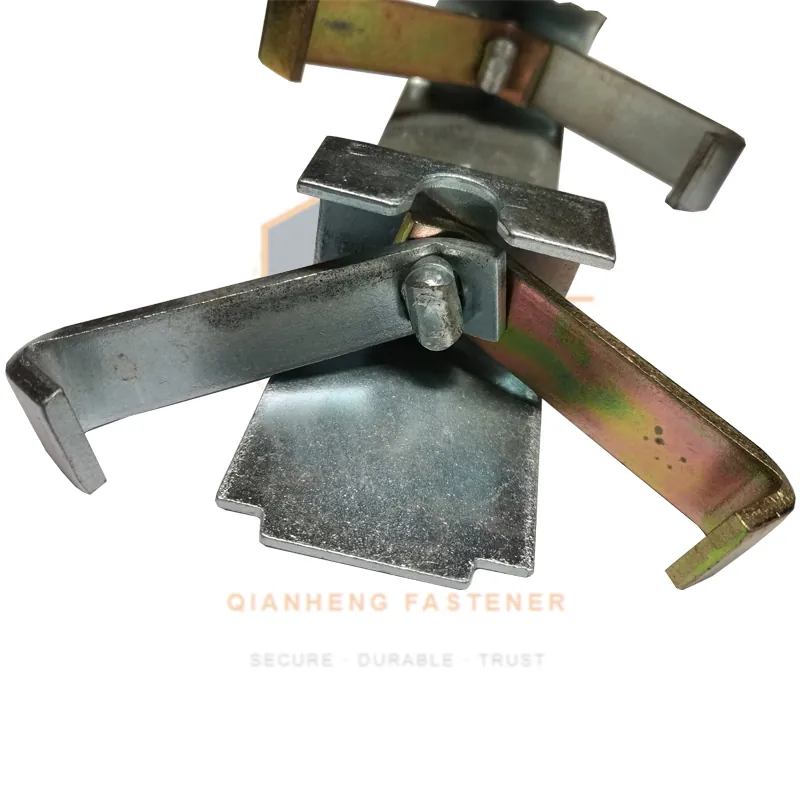
What the claw actually does
An H20 beam carries its load in two timber flanges connected by a plywood web. The flange is the only part of the beam that has the section to take a clamp, so the claw is shaped around it: a toothed hook closes over the 80 mm flange, a spring holds it closed, and a wedge locks the whole thing off. The body of the claw then ties the beam to the panel edge or the waling.
Done right, this gives three things:
- No beam damage. No screws through the flange, so the beam keeps its full rated bending and shear values and stays in the rental fleet.
- One-hand installation. Hook, close, wedge — a few seconds per claw with no tools, which is why the fitting dominates panel assembly on Hünnebeck-style gang forms.
- Position anywhere. Unlike fixed panel ties, the claw grips the flange at any point along the beam, so the layout can follow the actual load, not a hole grid.
Why most claws are stamped
The standard manufacturing route is press-stamping from Q235 steel plate: blank, punch, form, weld the hook spring seat, zinc plate. Stamping matters to the buyer for three reasons.
Consistency. A press die produces the same geometry ten thousand times. The tooth profile that grips the flange is identical on every part, so grip force is predictable across the shipment — which is what you want when a panel layout calculation assumes a known holding value per claw.
Ductility. Plate steel bends before it breaks. A claw that has been overloaded or dropped shows it: the hook opens slightly, the tooth profile rounds off. Site crews can reject a suspect claw at a glance. Cast iron, by contrast, fails suddenly — which is why stamped claws are the default for high-turnover panel work, while cast and ductile iron hooks belong on the H20 beam clamp, where rigidity under the wing nut matters more than impact tolerance.
Cost at volume. At several hundred claws per panel and thousands of panels, the press route is what keeps the fitting cheap enough to treat as a semi-consumable.
The process has one real weak point: die wear. As the cutting edges round off, stamped edges pick up micro-cracks, and those cracks grow under repeated flexing. This is a supplier problem more than a design problem — buy from a factory that maintains and re-cuts dies on schedule, not from whoever is running the oldest tooling in town.
What to check before ordering
- Flange fit. Confirm the claw matches the 80 mm H20 flange. Claws made for lighter beams will rock on the flange and lose tooth contact.
- Tooth condition on samples. Ask for samples and look at the hook teeth under a loupe — sharp, clean edges; no burrs, no rounded profile.
- Spring force. The spring must hold the claw closed in the carton, through transport, and on the beam before wedging. Weak springs are the most common site complaint.
- Wedge lock security. The wedge should seat with hand pressure and resist vibration; test the assembly on a beam before releasing the shipment.
- Zinc class. Electro-zinc is fine for covered storage cycles; for outdoor or coastal sites, specify hot-dip galvanizing or a higher zinc class — claws get lost and replaced, but they should not rust out in one season.
- Spares ratio. Claws are light, which makes them the most commonly lost fitting on the panel. Order 5-10% over the layout count.
Where the claw stops and the clamp starts
The claw fixes the beam to the panel. The beam-to-waling connection — where the pour pressure actually passes into the steel walers — is a different joint with a different fitting. That is the job of the H20 timber beam clamp, a U-bolt body with left/right hooks and a wing nut, rated for heavy-duty wall formwork. Specifying one fitting for both joints is the most common layout mistake: claws on the waling connection slip under load, and clamps on the panel connection slow the crew down for nothing.
Procurement summary
Order the claw as a matched system — claw, wedge and spring from one source — and state the flange width, zinc class and sample approval on the purchase order. A claw costs little; a panel that sheds beams during a pour costs the schedule.