
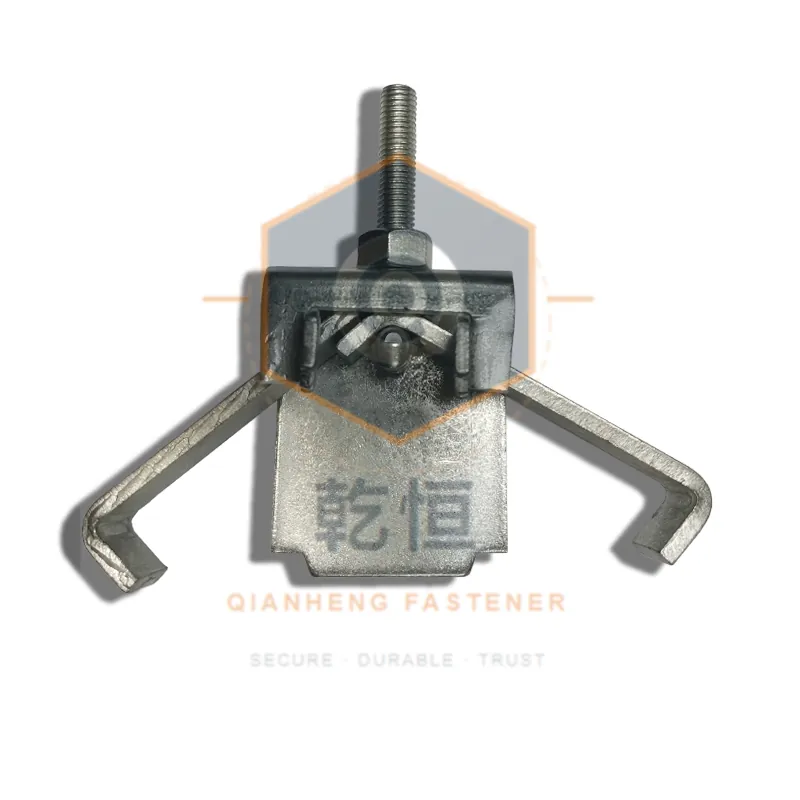
Conector de viga H20
Une los extremos de vigas de madera H20; transmisión de carga clara y montaje rápido.
- Encaja en la brida de la viga H20 (80 mm)
- Gancho de fundición dúctil QT450-10
- Agarre dentado con resorte
Conectores de viga H20 y abrazaderas para vigas H20 para unir y fijar sistemas de encofrado con vigas H20.
Las vigas de madera H20 trasladan la carga del panel a los largueros, y las uniones deciden si el sistema se mantiene rígido. Esta serie cubre el conector que une los extremos de las vigas y la abrazadera cuya garra de acero fundido agarra el ala de la viga.
Une los extremos de vigas de madera H20; transmisión de carga clara y montaje rápido.

Garra de acero fundido agarra el ala de la viga H20; tornillo y tuerca la bloquean.
H20 timber beams carry the panel load back to the walers, and the beam joints are where a slab form loses its line. The H20 beam connector joins two beam ends so the splice carries moment rather than acting as a hinge; the H20 timber beam clamp grips the beam flange to fix a waler, a prop head or a bracing point without drilling the beam. Both parts are reused across many cycles, so the grip and the casting quality matter more than the unit price.
The clamp fits the standard 80 mm H20 beam flange. The hook is QT450-10 ductile iron with a spring-loaded toothed grip that bites the flange instead of relying on friction, and the wedge lock needs no tools, so it goes on and off in seconds with gloves on. Check the flange width on your beam supply before ordering — non-standard timber beams are the usual cause of a clamp that will not seat. Connectors are matched to the beam depth so the splice sits flush with the beam face.
These are long-life parts, so the order quantity follows the number of beams in the system plus spares — a clamp lost on site stops a beam from being fixed. Standard clamps and connectors ship from stock in about three days, special castings in 7–15 days. Ductile iron with black or galvanized finish; galvanized is worth specifying where beams are stored outdoors between cycles.
Un tirante de encofrado es una barra roscada de alta resistencia que, junto con tuercas, placas de anclaje y largueros, mantiene los paneles de encofrado frente a la presión lateral del hormigón fresco. Atraviesa la sección del muro y se recupera por completo tras el desencofrado (tirante pasante usado con manguito) o queda empotrado de forma permanente (tipo de extremo perdido / hidrófugo).