
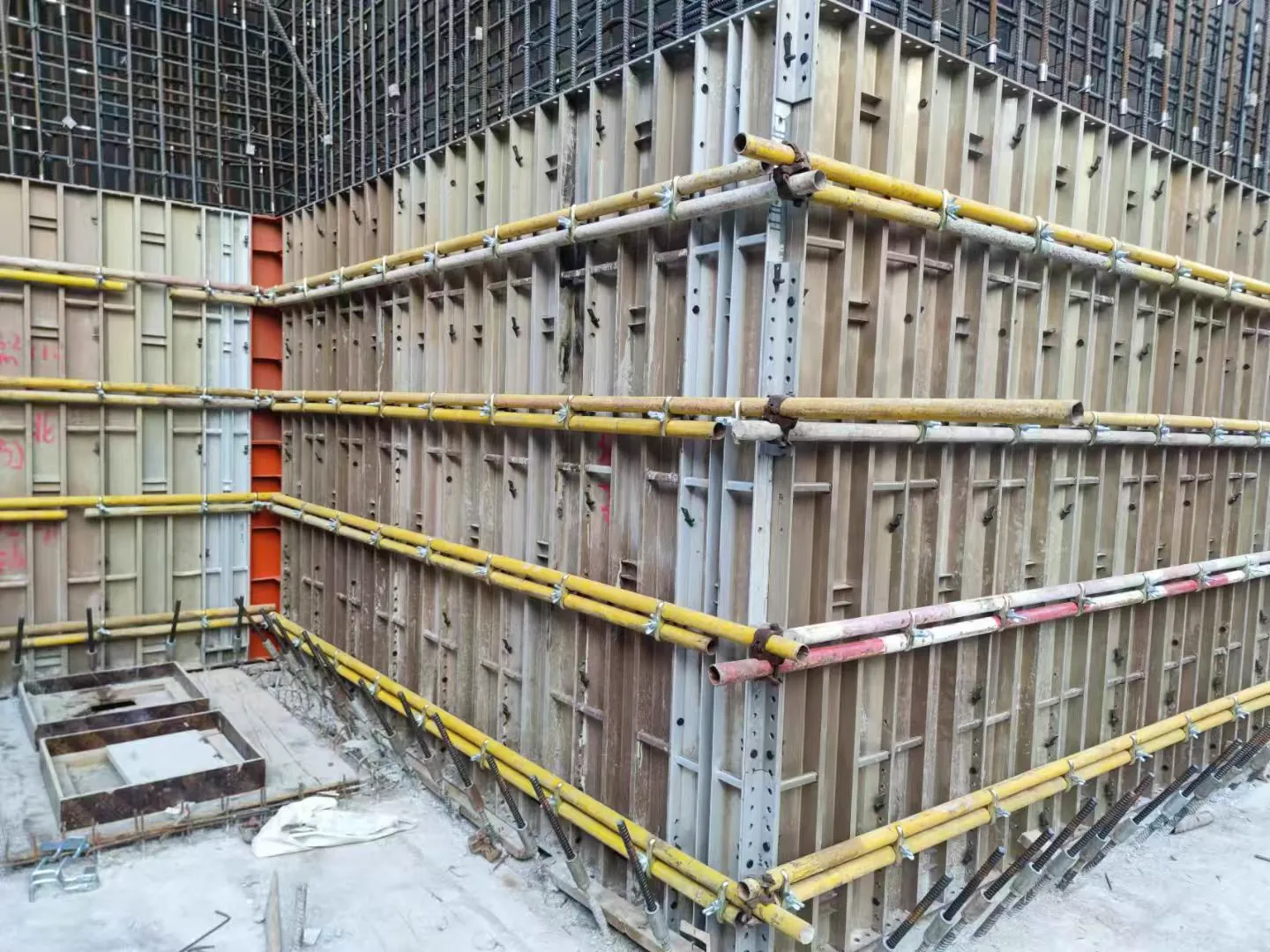
Washer Plate Bearing Area: Where Formwork Ties Fail
> In brief > - The tension member is strong; the bearing surface under it usually is not. > - Bearing stress is force divided by net contact area, not by the plate outline. > - Plate thickness governs whether the plate bears flat or only at its edges. > - A crushed waler looks like a loose nut, and gets treated as one.
Tie rod failures are investigated as if they were rod failures. The rod is proof-tested, the grade is on the certificate, the diameter was calculated. What actually gives way, in the majority of site failures we are asked to look at, is the few square centimetres between the nut and the timber. Once that surface crushes, the preload disappears, the assembly goes slack, and the wall moves under a load the rod was perfectly capable of carrying.
Our own production and test data are available on request — see how our factory works and contact the engineering team for the documents behind any figure quoted here.
Bearing stress is the contact pressure between two surfaces pressed together — here, the plate and the waler. Net contact area is the plate area minus the central hole, because the hole carries nothing. Preload is the tension left in the rod after tightening, and it is what keeps the formwork closed before the concrete starts pushing. Dishing is the permanent cupping of a plate that has been overloaded in the centre.
The calculation everyone skips
The check takes one line. Divide the rod force by the net area of the plate, and compare it with the bearing capacity of whatever the plate sits on.
| Plate | Hole | Net area | 48 kN rod | 75 kN rod | 108 kN rod |
|---|---|---|---|---|---|
| 80 x 80 x 6 | 18 mm | 6,146 mm2 | 7.8 N/mm2 | 12.2 N/mm2 | 17.6 N/mm2 |
| 100 x 100 x 6 | 18 mm | 9,746 mm2 | 4.9 N/mm2 | 7.7 N/mm2 | 11.1 N/mm2 |
| 100 x 100 x 8 | 18 mm | 9,746 mm2 | 4.9 N/mm2 | 7.7 N/mm2 | 11.1 N/mm2 |
| 120 x 120 x 8 | 22 mm | 14,020 mm2 | 3.4 N/mm2 | 5.3 N/mm2 | 7.7 N/mm2 |
| 150 x 150 x 10 | 22 mm | 22,120 mm2 | 2.2 N/mm2 | 3.4 N/mm2 | 4.9 N/mm2 |
Read the 75 kN column against what the plate is sitting on. Structural softwood loaded perpendicular to grain carries a fraction of that — the characteristic value for C24 is 2.5 N/mm2, and formwork timber is not always C24. Plywood is worse. So a 100x100 plate on a timber waler at 75 kN is not a marginal case, it is an overload in bearing by roughly three times, and the only reason it does not always show is that the load is spread along a continuous waler rather than landing on one plate in isolation.
That last point matters, and it is why the strict P/A check over-predicts failure on real sites. A continuous timber waler distributes the plate load over a length either side of the plate. The check above is therefore a local check: it tells you whether the timber directly under the plate will crush before the waler bends, not whether the wall will fall down. Both checks are needed, and only one of them is normally done.
Thickness decides whether the plate bears at all
A plate that bends does not distribute load. It touches the waler at its edges and arches over the middle, so the real contact area is two narrow strips instead of the full face — and the bearing stress on those strips is several times the calculated average.
The practical rule from our own production: a square plate carrying a D15 rod at working load should be at least 8 mm thick, and 10 mm is the safer default for D20. At 6 mm the plate is adequate for D12 and for light pours, and it is the plate we see dished most often on returned stock.
Thickness is also the cheapest thing to get wrong in the other direction. A 12 mm plate costs more steel and weighs more in freight, and on a steel waler it buys nothing, because the steel section under it is stiff enough that the plate never needs to bridge a gap.
What the plate sits on decides the answer
The same 100x100 plate is generous on one waler and inadequate on another, and the difference is the material in contact.
| Waler under the plate | Bearing limit | 100x100 plate at 75 kN | What to do |
|---|---|---|---|
| Steel channel or H20 steel | Not the governing check | Fine | Keep 6–8 mm plate, check the waler, not the plate |
| H20 timber beam | Moderate, grain direction matters | Marginal | 8 mm plate minimum, verify with 120x120 if the beam is soft |
| Sawn timber waler, 100 x 100 | Low | Overloaded locally | 120x120 x 8, or a steel spreader plate |
| Plywood face only, no waler | Very low | Fails | Never bear a nut directly on a panel face |
| Double 50 mm timber, staggered joints | Moderate | Marginal | Stagger the plates so no two land on the same joint |
The last row is the one that catches people. Two plates landing either side of a timber splice put the whole load into the fixings holding that splice together, and the splice is not designed for it. On wall layouts where the waler has to be joined, the tie positions and the splice positions have to be set together — which is the same exercise as laying out column ties and clamps, just in one dimension.
Round versus square versus plum
Three plate shapes dominate export stock, and they are not interchangeable.
Square plate washers bear on four flat edges and spread load in both directions. They are the default for timber walers and the easiest to check, because the contact ring in the timber is a clean square.
Plum (wing) washers are pressed from strip with a raised centre. They contact the waler mainly along two long edges, which makes them effective on a steel section or a stiff beam and poor on soft timber. Their outline area overstates their bearing area by a wide margin — a 120 x 60 plum washer is not equivalent to a 120 x 60 flat plate.
Disc and combination nuts integrate the bearing surface into the nut itself. That saves a part and a handling step, and it works, provided the integrated face is large enough — a disc nut with a 60 mm diameter face is doing the same bearing job as a 60 mm plate, not a 100 mm one. The full family, and which of them can be swapped without changing the assembly, is set out in identifying the tie rod nut family.
The three field signs, in order
Bearing failure is progressive and gives warning. It is usually missed because the warning looks like a different problem.
- A compression ring in the timber around the plate outline, visible as a dark, denser line. This is the first stage: the surface fibres have crushed, the plate has bedded in, and preload has dropped but not vanished. Re-tightening here still works.
- The plate rocks when you press one corner. The timber under it is now uneven, so the plate has lost full contact and the load is on a corner. Re-tightening here makes it worse, because the corner drives deeper.
- The plate is dished when laid on a flat surface. The plate itself has yielded. It will not flatten again under load, and its effective bearing area is now a ring. Replace it.
At stage two and three the assembly has the classic appearance of a loose nut, and the standard response — tighten it — is exactly wrong. This is the same failure path described in why formwork fasteners fail, arriving from the bearing side instead of the thread side.
Sizing rule for a quotation
When a customer sends a wall layout and asks for rods and nuts, the plate size is the item most often left as "whatever is in stock". Our rule of thumb for quoting:
- Take the working load per rod from the layout, not from the rod's proof load.
- Divide by 2.5 N/mm2 to get the minimum net area on timber, or by the waler's own bearing capacity on steel.
- Add the hole back in to convert net area to plate size.
- Round up to the next standard size in the range, and never round down to save a part.
For a D15 rod at 75 kN on timber that gives about 30,000 mm2 net, which is a 175 x 175 plate — larger than anything in a standard catalogue. That is not a reason to specify a 175 mm plate; it is a signal that the rod load is too high for a timber waler at that spacing, and the layout needs one more row of ties or a steel waler. Getting that signal at the quotation stage is worth more than any plate you can sell.
Questions we get from buyers
The full specification for our square plate washers — sizes 100x100 and 120x120, thickness 6 to 10 mm, hole matched to D12, D15 or D20 — is on the TP square washer page, and the pressed plum version is on the plum washer page. Both are stocked, and both are quoted with the plate thickness stated rather than assumed, because it is the number that decides whether the part works.
If you are comparing quotations and one supplier is cheaper on plates, the difference is almost always thickness. A 6 mm plate and a 10 mm plate have the same outline and the same description on a quotation, and they behave differently at the load the wall actually applies. Comparing fastener quotations like for like covers the other line items that hide the same way.